• 信息
12+ 年
经验
1
产品
1030
演示版
0
工作
3
信号
3
订阅者
Algo trader, author of Bratislava EA, Stabilis Lucra, PrismaForex.
Author of academic algo articles: https://scholar.google.com/scholar?hl=cs&as_sdt=0%2C5&q=david+jukl&oq=david+jukl
David Jukl
David Jukl
WHY CAGR IS NOT ENOUGH: TESTING A NEW RISK METRIC FOR GRID AND MARTINGALE STRATEGIES

What makes an automated trading strategy robust?

It is not only the entry signal or the final annual return. In leveraged trading, the result can also be strongly influenced by position sizing, margin utilisation, basket depth, the sequence of market movements and the rules used to close positions when account conditions change.

This is the subject of my current academic research and development work.

We are now testing two new MetaTrader 5 implementations of the Prisma S&P 500 strategy:

• Classic v2.30 – designed to preserve the established trading logic while transferring it to MT5.

• FullAuto v2.40 – an extended version introducing more automated management of exposure, equity and margin conditions.

WHY CAGR CAN BE MISLEADING

Trading systems are often compared primarily by Compound Annual Growth Rate (CAGR), maximum drawdown or the Calmar ratio.

These measures are useful, but they may not fully describe the risk of grid and martingale-style strategies.

A grid strategy can generate a long sequence of relatively small profits while gradually accumulating exposure during an adverse market move. Two configurations may therefore achieve a similar CAGR and maximum drawdown, even though one of them spends much more time operating with a severely depleted free-margin cushion.

For a leveraged grid strategy, this distinction can be critical. The binding constraint is often not ordinary volatility, but available margin.

A NEW METRIC: RETURN ON MARGIN STRESS

In my current research, I propose a new evaluation metric called Return on Margin Stress, or RoMS.

RoMS relates strategy growth to the time-weighted depletion of the account’s margin cushion. In simple terms, it asks:

How much return did the strategy generate relative to the intensity and duration of the margin stress it had to withstand?

I also introduce the Margin Cushion Coefficient, which expresses the remaining margin capacity as a normalised state variable.

These measures are particularly relevant to grid and martingale strategies because their risk may accumulate gradually and remain partly hidden behind a smooth balance curve.

In seven tick-level backtests covering 2012–2026, RoMS produced a substantially different ranking of strategy configurations from the traditional Calmar ratio. The Spearman rank correlation was −0.68, meaning that configurations that looked attractive under a conventional return-to-drawdown measure could appear much less attractive once the duration and severity of margin stress were considered.

This does not mean that RoMS replaces CAGR, maximum drawdown or the Calmar ratio. We use it alongside them to obtain a more complete picture of leveraged-strategy risk.

WHAT WE ARE TESTING NOW

Our current evaluation therefore does not focus only on the highest possible backtest profit. We compare the new MT5 configurations using:

• CAGR
• maximum drawdown
• Calmar ratio
• Return on Margin Stress
• margin-cushion depletion
• peak effective leverage
• recovery after adverse periods
• balance and equity behaviour
• stability outside the optimisation period
• sensitivity to execution assumptions

The underlying scientific question is whether state-dependent exit rules can improve the behaviour of a leveraged strategy during adverse market conditions without unnecessarily limiting its performance during normal periods.

The new MT5 versions are still being tested. They are not being presented as finished products, and no preliminary backtest result should be interpreted as a guarantee of future performance.

At the same time, the existing Prisma S&P 500 strategy continues to trade on a live account with publicly available results.

I describe this methodology in detail in my new academic paper prepared at the University of Finance and Administration (VŠFS) in Prague, which is scheduled for publication in January.

If you are interested in RoMS, margin-state-dependent exits or the research behind the new Prisma S&P 500 versions, feel free to send me a private message. I will be happy to discuss the methodology and its practical application.

⭐⭐⭐⭐⭐ Follow the Prisma SP500 live signal on MQL5:
https://www.mql5.com/en/signals/2398332

The goal is straightforward: combine academic discipline with practical trading experience and improve the strategy only when the evidence supports the change.

Past performance is not indicative of future results. Trading involves risk.
David Jukl 发布MetaTrader 4信号
Prisma SP500
价格:30 USD, 增长:76.33%
Trading of SP500 from PhD in Finance, David Jukl from Prague
David Jukl
David Jukl
Second Half of October: Prisma S&P 500 Advanced Despite Renewed Market Volatility

The second half of October brought a demanding environment for equity markets.

The Federal Reserve kept interest rates unchanged at 3.75–4.00%, while emphasizing that inflation remained elevated. The decision was not unanimous, with two members preferring a rate increase. At the end of the month, renewed concerns about technology valuations contributed to a sharp sell-off, including a 1.8% daily decline in the S&P 500 and a 2.9% fall in the Nasdaq.

Against this volatile backdrop, Prisma S&P 500 Live continued to progress:

• Equity change from 15 to 31 October: +2.87%
• Balance change: +1.65%
• Total verified gain: +73.32%
• Historical maximum drawdown: 8.71%
• Equity at the reporting date: 99.95% of balance

The key result is not simply that the account finished the period higher. The strategy increased its equity while the broader market faced renewed pressure and remained almost fully aligned between balance and equity, without a significant floating loss at the reporting date.

MA Trader LIVE increased its closed balance by 3.03%, although its equity declined by 6.53% due to open positions. We consider it important to report this distinction transparently rather than presenting closed results alone.

Prisma S&P 500 verified results:


MA Trader LIVE – VIP strategy available on request:


For more information about Prisma S&P 500, please send me a private message.

Past performance is not indicative of future results. Trading involves risk.
David Jukl
David Jukl
First Half of October: Both Verified Systems Closed Higher

Between 1 and 14 October 2026, both publicly verified trading systems delivered positive results from closed trades.

Prisma S&P 500

• Period gain: +0.79%
• Equity change: +0.20%
• Trades executed: 6
• Current cumulative gain: +70.51%
• Historical maximum drawdown: 8.71%
• Current equity: 98.77% of balance

MA Trader VIP

• Period gain: +1.13%
• Equity change: +0.84%
• Trades executed: 7
• Current cumulative gain: +489.83%
• Historical maximum drawdown: 33.12%
• Current equity: 99.77% of balance

The difference between closed-trade performance and equity growth reflects positions that remained open at the end of the reporting period. We therefore report both figures rather than presenting floating results as completed gains.

The period was positive for both systems, although their long-term risk profiles remain different. Prisma S&P 500 continues to show the lower historical drawdown, while MA Trader VIP has generated stronger cumulative growth with materially higher historical risk.

Verified live accounts:

Prisma S&P 500:


MA Trader VIP:


If you would like more information about either system, send me a private message.

Past performance is not indicative of future results. Trading involves risk, including the possible loss of capital.
David Jukl
David Jukl
Prisma S&P 500 – Q3 2026 Review: +43.42% YTD with a 5.32% Drawdown

The third quarter of 2026 repeatedly tested systematic traders through changing interest-rate expectations, volatile bond yields and uneven equity-market conditions.

At the end of Q3, Prisma S&P 500 recorded the following verified year-to-date results on a real trading account:

• Gain: +43.42%
• Profit: €512.65
• Maximum drawdown: 5.32%
• Trades executed: 482
• Winning trades: 52%
• Current balance: €1,693.39
• Current equity: €1,682.35 — 99.35% of balance

The 52% win rate is particularly important. A genuine trading edge does not require winning every trade. It comes from consistent execution, disciplined risk management and a favourable relationship between profitable and losing trades over time.

The account’s equity remains close to its balance, while the year-to-date gain substantially exceeds the recorded drawdown. For me, this combination is more meaningful than return alone.

The results are publicly verifiable on Myfxbook:


If you would like to learn more about Prisma S&P 500, send me a private message.

Past performance is not indicative of future results. Trading involves risk, and losses may occur.
David Jukl
David Jukl
Two Weeks That Tested Our Trading Robots

Between 9 and 23 September, markets had to absorb oil prices above $100, renewed inflation concerns, the Federal Reserve’s first rate increase in more than three years, a stronger US dollar and sharp swings in both gold and equity markets.

The S&P 500 initially came under pressure before rebounding, while gold reacted strongly to changing interest-rate expectations.

This is exactly the type of environment in which emotions can damage trading decisions. Our automated systems continued to follow their predefined rules without discretionary intervention.

How did they perform?

🔵 Prisma S&P 500 was the strongest performer. Balance increased by 1.28% and equity by 1.23%. At the end of the period, balance and equity were both €1,692.54, meaning there was no floating loss at the time of measurement.

🟡 Prisma Gold increased its balance by 0.30%. Current equity represents 96.00% of balance because some positions remain open. We do not present floating positions as completed results—their final outcome will be reflected in the next update.

⭐ MA Trader VIP increased its balance by 0.58% through closed trades. However, its equity declined by 1.39% during the period because of open positions. Current equity remains at 97.99% of balance.

Not every line moves smoothly, especially during volatile markets. The real edge of systematic trading is not avoiding every fluctuation, but consistently executing a tested strategy without emotional decisions.

Verified live accounts:

Prisma Gold:


Prisma S&P 500:


MA Trader VIP:


Past performance is not indicative of future results. Trading involves risk, including the possible loss of capital.
David Jukl
David Jukl
🎓 Two New Peer-Reviewed Publications in Algorithmic Trading and Financial Markets

I am pleased to share two new scientific publications that expand my research at the intersection of algorithmic trading, financial machine learning and market regulation.

📄 1. “Bias-Corrected Feature Selection for Financial Time Series Forecasting: A Large-Scale Evaluation Across 40 Global Assets”
Published in Data Science in Finance and Economics (2026, Vol. 6, Issue 3).

The study evaluates a new bias-corrected feature-selection method across 40 global financial assets. Its purpose is to reduce systematic long/short prediction bias and improve the reliability of machine-learning models used in financial forecasting and algorithmic trading.

https://doi.org/10.3934/DSFE.2026013

The journal is ranked Q2. This means it belongs to the second quartile of journals in its field—approximately the top 25–50% according to academic impact and citation-based rankings. Publishing in a Q2 journal therefore represents a recognized international research standard.

📄 2. “Regulatory Effectiveness in Algorithmic and High-Frequency Trading: A Critical Assessment”
Published in ACTA VŠFS – Economic Studies and Analyses (2026, Vol. 20, Issue 1).

The paper examines whether the EU’s MiFID II framework and the US SEC’s supervisory approach adequately address the risks created by autonomous trading algorithms and high-frequency trading, including market integrity and systemic-risk concerns.

https://doi.org/10.37355/acta-2026/1-01

Together with my earlier publications, including Systematic Review on Algorithmic Trading and Bias-Corrected Feature Selection for Short-Horizon FX Trading, this work reflects my specialization in algorithmic trading, financial forecasting, machine learning and trading-system risk management.

I combine approximately 20 years of practical financial-market experience with peer-reviewed academic research. This allows me to approach trading-system development not only as a practitioner, but as a specialist applying scientifically validated methods to real-world markets.

Google Scholar: https://scholar.google.com/scholar?hl=en&q=David+Jukl
David Jukl
David Jukl
🎓 New Research Published: Bias-Corrected Feature Selection for FX Trading
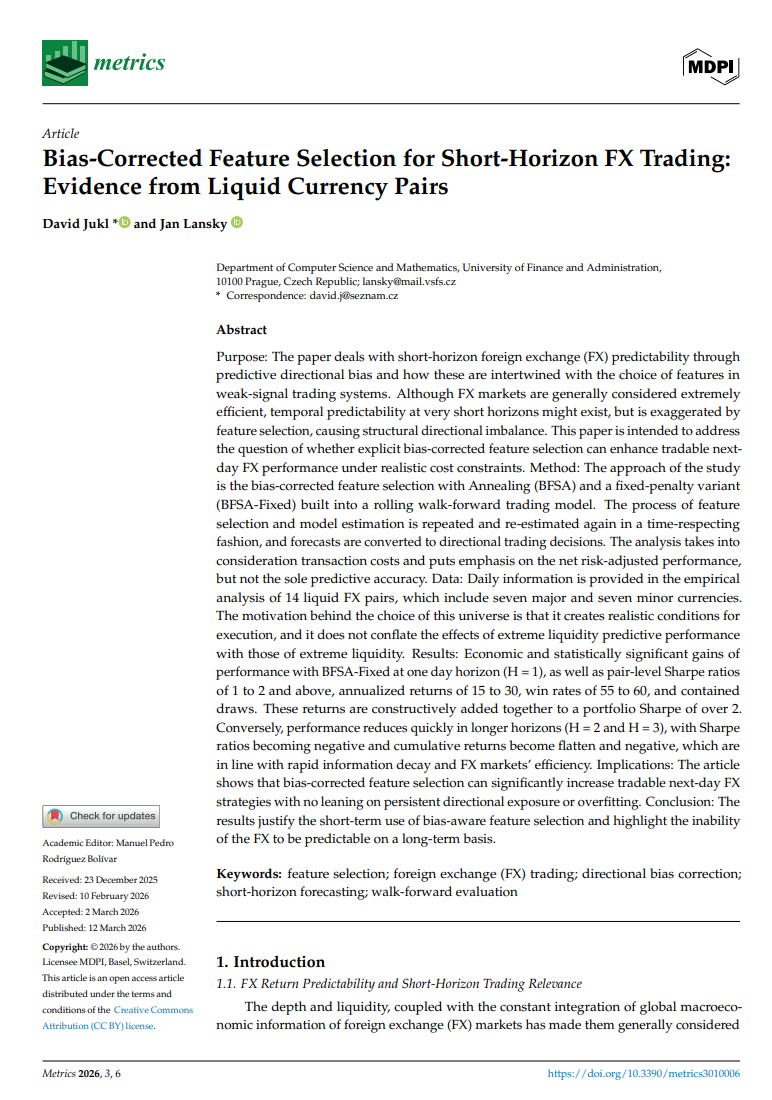
Following my previous publication in Acta Informatica Pragensia, I'm excited to share that my new peer-reviewed article has just been published today in the MDPI journal Metrics, co-authored with Jan Lansky from the University of Finance and Administration in Prague.
📄 "Bias-Corrected Feature Selection for Short-Horizon FX Trading: Evidence from Liquid Currency Pairs"
🔗 https://www.mdpi.com/3042-5042/3/1/6

Why does this matter for Forex traders and algo developers?
One of the most overlooked problems in algorithmic FX trading is directional bias — when your ML model quietly develops a preference for always going long (or always short), inflating backtest results in ways that collapse in live trading. This paper addresses exactly that.
The study introduces BFSA (Bias-Corrected Feature Selection with Annealing) — a feature selection framework that explicitly penalizes directional imbalance during the selection process, not just after the fact.
Key findings across 14 liquid currency pairs (7 majors + 7 minors):
✅ At H=1 (next-day horizon), BFSA-Fixed delivers Sharpe ratios of 1–2+ at the pair level, rising to a portfolio Sharpe above 2.0
✅ Annualized returns of 15–30% net of transaction costs
✅ Win rates of 55–60% — consistent and realistic, not overfitted
✅ Maximum drawdowns contained at −5% to −10%
✅ At H=2 and H=3, performance predictably degrades — exactly as efficient market theory would suggest, and a strong argument against overfitting
Why is this relevant for MetaTrader developers?
The walk-forward methodology mirrors real EA deployment — models are re-fitted on rolling windows, feature selection is re-run at each step, and costs are explicitly modeled. If you've ever wondered why your backtested EA performs differently in live trading, directional bias in feature selection is one of the most common hidden culprits.
The scientific, research-driven approach pays off — both in the lab and on the live account. 📈

Full article (open access): https://www.mdpi.com/3042-5042/3/1/6
David Jukl
David Jukl
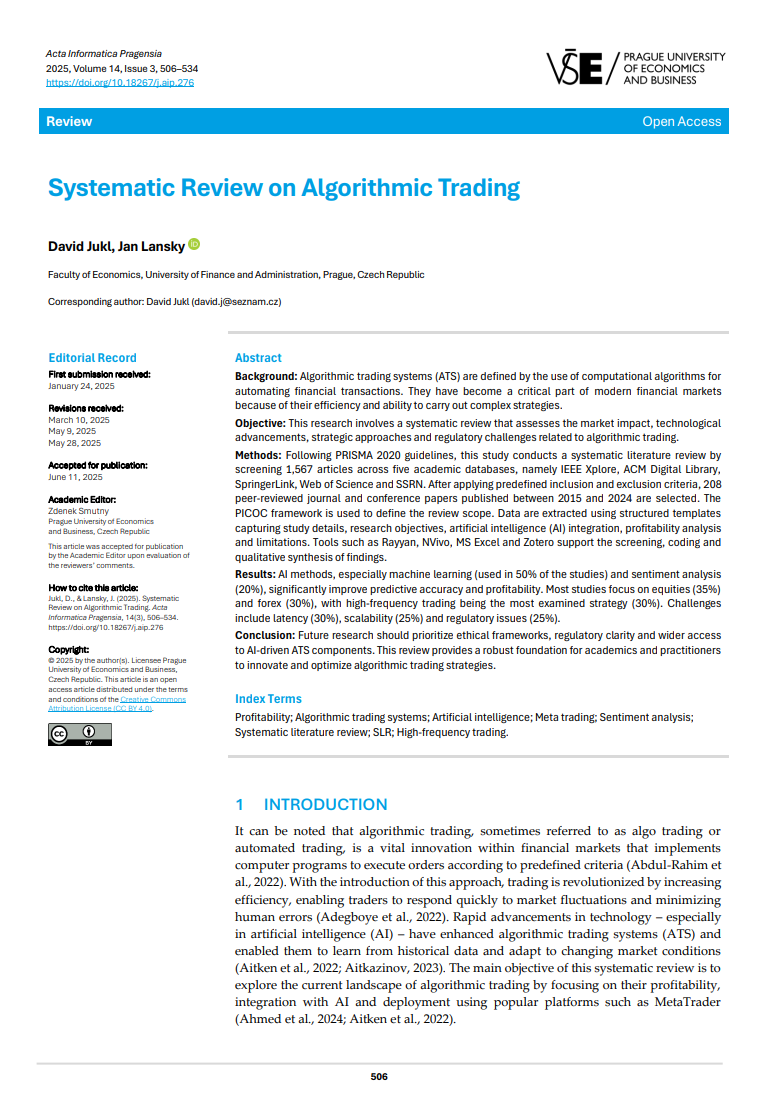
Based on my 20 years of experience in the Forex markets, I’ve published a new research article in the scientific journal Acta Informatica Pragensia.

The paper explores recent trends in machine learning applied to algorithmic trading, with a strong focus on practical implementation in MetaTrader 4.

In developing my trading algorithms, I consistently apply a scientific, research-driven approach — and in the long run, this methodology clearly pays off.

📄 Full article available here:
https://aip.vse.cz/pdfs/aip/2025/03/13.pdf
David Jukl 发布MetaTrader 4信号
PrismaForexPro2
价格:30 USD, 增长:259.21%
Multi currency algo trading 
David Jukl 发布MetaTrader 4信号
"PrismaForexPro"不可用
David Jukl 发布MetaTrader 4信号
PrismaForex
价格:35 USD, 增长:505.57%
Hi, I'm David. I have been involved in institutional trading and investments for a long time. The trading system is built on similar principles of institutional trading. This is why the results of the system are very stable. The best Forex trader is a fine-tuned and well-tested system trading on AUD/CAD and EUR/GBP currency pairs. Uses advanced report capital, profit management according to account load. This makes the system relatively safe with respect to high profit. The system has a built-in
David Jukl
David Jukl
With the new version of the Prisma v_1.7 trading system, we have started to prepare settings that can be used by clients for whom a larger drawdown is not desirable and for whom security and even greater stability of the system is preferred to high profits.

The profit to maximum DD here comes out to about 10:1. In this case, the maximum DD on the currency pair is set to a value of e.g. 15% as an additional safety net.
This setting can be used on a cent account from a capital of 4000 EUR. For larger trading accounts (from 40000 EUR) a classic trading account can also be used or even ECN accounts with a smaller spread and a separate fee for open/close positions.

With Prisma you can use up to 4 currency pairs on one trading account and up to two trading accounts at the same time. Up to 8 currency pairs in total. This achieves a very good profitability of the system with a small risk of larger drops and at the same time diversifying the risk into 2 trading accounts.

Contact us for more information or download the free trial and we will discuss all the details with you or set up the system according to your preferences.

David
David Jukl 已发布产品

1300.00 USD

The Prisma Expert Advisor is a set of rules that allows you to achieve consistent results on the FOREX currency market thanks to sophisticated open position management, quality money management and opening and closing of positions, where mathematics together with probability play the main role. Prisma is able to work with stability on all major currency pairs and their combinations provided the system is run with a suitable broker that offers favorable conditions for such trading. However, it is

David Jukl
David Jukl
Lets look how my expert advisor (forex robot) Stabilis Lucra performs 6 months after official launch.

https://youtu.be/bSip_q7iww8

Audited results by MyFxbook in a nutshell:
Deposit in June 2013: 100.000USD
Withdrawals up to now: 100.000USD
>>>Profit: 182.900USD<<<

Full report in video, cannot add MyFXbook statement here - admin restrictions ;)

Do you want to know more? Write me

LinkedIN: https://www.linkedin.com/in/davidjukl
FB: https://www.facebook.com/stabilislucra/
David Jukl
David Jukl
Check my current results on 500USD and 10.000USD LIVE FxChoice accounts:


It can be purchased on my site www.stabilislucra.com
David Jukl
David Jukl
Hello Guys, a new trading week commences so its time for a quick recap of what happened at Stabilis Lucra last week! All details at www.stabilislucra.com

The bitcoin trade Plugin of stabilis lucra did an amazing jo of raking in 35% profits!

Bitcoin plugin last week + 180USD +35%: https://charts.mql5.com/16/568/bitcoin-h1-instaforex-group.png

So in total profits soared over 88% .. nifty ;)


The pecunia accelerator made 20% gain!

Pecunia Accelerator + 92USD (+20%) https://charts.mql5.com/16/568/eurgbp-m5-instaforex-group.png

Stabilis Lucra our main baby opened trades that currently sit at -4% but this is normal and it will close in profit.. remember its the long term safe solution! and always starts low and over weeks evens out trades at profits.. think of as the long term BASE plan that just never looses.. and never did since years :)

Algos, a development by our in house lab has pocketed an insane 50% gain!! (Available to LAB members!)

Algos: Total + 440USD, +247USD last week (+50%) https://charts.mql5.com/16/568/eurusd-m5-instaforex-group.png

The Anniversary free gift Access Smartpocket made a respectable +6%

Smart Pocket: total + 432USD, +31USD last week (+6%)

All in all another terrific week with lots of gains!

See you inside the members area and wish you another great week ahead!

http://www.stabilislucra.com

David Jukl
12