Syed Jawad Hussain Naqvi
  • 정보
no
경험
4
제품
4
데모 버전
0
작업
0
거래 신호
0
구독자
Founder & Quant Developer 에 Kernelis Capital
X
Quantitative Developer 🇵🇰

• MQL5 Author — algorithmic trading systems built on statistical modeling, recursive signal processing, and quantitative market analysis
• Technical skills: MQL5, Python, C++, statistical modeling, competitive programming
• Focus: correct engineering — proper recursive state management, honest backtesting, no shortcuts
• Belief: complex mathematics deserves clear, accessible explanations

📊 Working toward a career in quantitative finance

"If you can't explain it simply, you don't understand it well enough." — Albert Einstein
Syed Jawad Hussain Naqvi
A Markov chain is a mathematical system that models a sequence of random events where the probability of the next event depends entirely on the current state, not on how the system arrived there. This "memoryless" characteristic is known as the Markov property.

How It Works
A Markov chain requires three main components:
States: All possible conditions or positions the system can be in (e.g., Sunny or Rainy).Transition Probabilities: The likelihood of moving from one specific state to another.T
ransition Matrix: A mathematical grid (or matrix) that organizes all transition probabilities.
Syed Jawad Hussain Naqvi 출시돈 제품

Take control of your trading performance with the Pro Dashboard Screener  Designed for serious traders, this utility provides a clean, professional, and real-time overview of your account's health directly on your chart. Stop switching between tabs to check your stats. With the Quant Pro Dashboard, your key metrics are always front and center, allowing you to focus on what matters most: your analysis. Key Features: Account Intelligence: Automatically detects your Account Number and Broker

Syed Jawad Hussain Naqvi
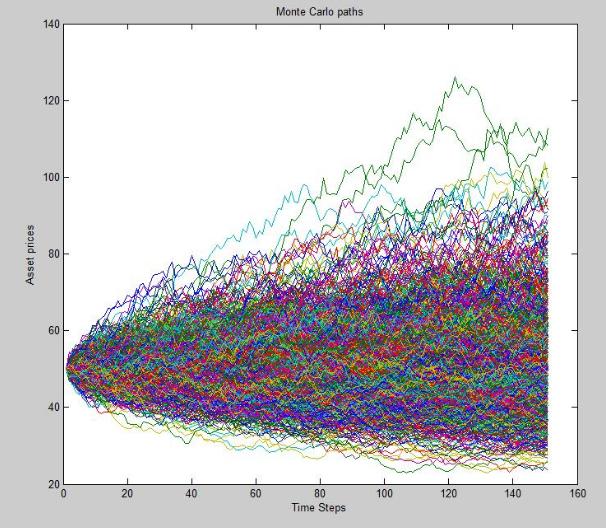
A Monte Carlo simulation is a mathematical technique that uses repeated random sampling to estimate the probability of different outcomes in complex systems. Instead of providing a single guess, it models uncertainty by running thousands of scenarios, resulting in a probability distribution of what might happen.

How It Works:
The name was inspired by the famous casinos in Monaco, as chance and randomness are the core of the modeling approach.

The simulation relies on three fundamental steps:

Define Probability Distributions: Replace uncertain variables (like market returns or task durations) with probability distributions (e.g., normal, uniform).

Random Sampling: Use a computer to randomly pick a value for each uncertain variable.

Repeat and Aggregate: Run this process thousands or millions of times. The result is a large dataset of possible outcomes that shows the most likely results and their probabilities.
Syed Jawad Hussain Naqvi
MQL5.커뮤니티에 등록됨
12