First Five Breakout
- Experts
- 버전: 1.0
- 활성화: 5

First Five Breakout trades the first minutes of the US cash session on the Nasdaq 100 index CFD (US100, NAS100, USTEC, depending on the broker).
HOW IT WORKS
- At 09:30 New York time the EA measures the high and low of the first 5 minutes (the opening range).
- It places a buy stop at the range high and a sell stop at the range low. When one is filled, the other is cancelled.
- The stop loss sits at the opposite side of the range. No fixed take profit by default: the trade runs until the stop or until 15 minutes before the cash close, when every position is closed.
- At most one trade per symbol per day. In the 2018-2026 test this gave about one trade per trading day.
- No position is held overnight, so no swap is paid.
RISK MANAGEMENT
- Position size is a fixed percentage of equity (default 0.3% per trade) lost if the stop is hit.
- No grid, no martingale, no averaging, no hedging.
- If the broker minimum lot is larger than the risk allows, the EA trades the minimum lot only while its real risk stays below a limit you set (default 2%), otherwise it skips the day.
- The day is skipped if the spread is too wide compared with the opening range. Free margin and the broker volume limit are checked before every order.
TIME ZONES
The New York open is found automatically in live trading, including daylight saving changes. In the Strategy Tester the EA assumes a broker on GMT+2/+3 with US daylight saving. If your broker uses another time zone, change the two Broker time inputs for testing. Use the Every tick or Real ticks model; the Open prices model does not show the opening minutes.
BACKTEST RESULTS (simulation, not live trading)
Admirals MT5 data, US100, 10,000 USD, 0.3% risk per trade, default inputs.
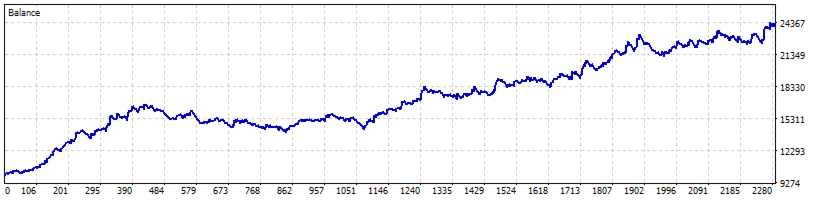
- 2018-2026, 1-minute OHLC: net profit +14,460 USD, profit factor 1.18, 2,281 trades, max equity drawdown 16.9%.
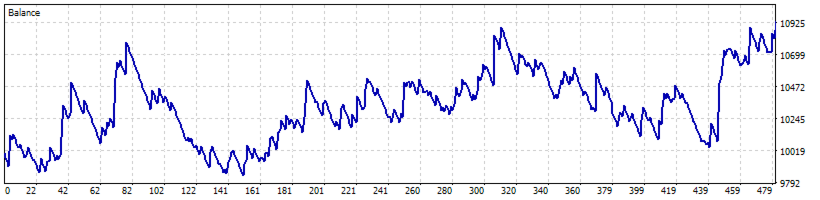
- 2025-2026, real ticks: net profit +944 USD, profit factor 1.09, 478 trades, max equity drawdown 9.9%.
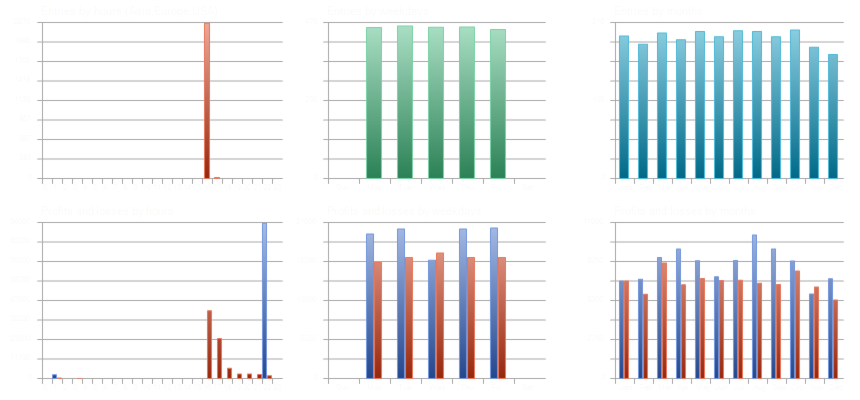
Eight of nine calendar years were positive in the test; 2020 was negative. Changing each main input by +/-20% kept the result positive, and so did adding extra trading costs.
The edge is modest. Real-tick results are weaker than 1-minute results because fills at the open are worse. Results depend on your broker's spread and execution at the New York open. Losing months and losing years are part of this strategy. Please test the EA on a demo account with your own broker before trading real money.
RECOMMENDED USE
- Symbol: Nasdaq 100 CFD (any chart timeframe; the EA uses M1 data internally).
- Account: hedging or netting; about 500 USD minimum with a broker that offers 0.01 lot on the index.
- Run on a VPS or a computer that is on during the New York session.
- Other indices (S&P 500, Dow Jones, DAX) are supported, but in our tests their results were close to break-even after costs and they are not recommended.
INPUTS
- Symbols: empty = chart symbol, or a comma list to trade several symbols from one chart.
- Exchange session: Auto (from the symbol name), New York, Frankfurt or London.
- Opening range: minutes after the cash open used to build the range (5).
- Stop distance: multiple of the range, 1 = opposite side (1.0).
- Take profit: multiple of the stop distance, 0 = off (0).
- Entry window: minutes after the open during which a breakout can be entered (180).
- Close before close: minutes before the cash close when positions are closed (15).
- Risk per trade: percent of equity (0.3).
- Min-lot risk limit: maximum risk in % when the minimum lot is used (2.0).
- Max lot: upper limit per trade (10).
- Max spread: skip the day if the spread is above this % of the range (50).
- Broker GMT offset / DST: used only in the Strategy Tester (2 / US).
- Magic number, comment: order identification.
RISK WARNING
Trading leveraged products carries a high risk of loss. Backtest results are simulations based on historical data and do not guarantee future results. Only trade with money you can afford to lose.