Opening Range Breakout ORB Entry Model
- Indicateurs
-
Ravi Shakya
 I’m Ravi Shakya, an MT5 developer with 5 years of trading experience in NEPSE and Forex. I use Smart Money Concepts (SMC) and price action to create simple and useful trading indicators, tools, and Expert Advisors.
 - Version: 2.13
- Activations: 10
The Opening Range Breakout indicator brings a complete, rule-based Smart Money Concepts entry model to MetaTrader 5. Built around the institutional logic of session DR manipulation, liquidity sweeps, and MSB confirmation, it identifies high-probability ORB setups across the London and New York sessions and guides you from the initial range formation all the way through to a defined entry, SL, and TP — with no manual work required.
The Concept
Smart Money operates within sessions. During the early hours of a session, institutions build their positions by engineering liquidity within a defined price range — the opening range. Once sufficient BSL and SSL has accumulated on both sides of the DR, price breaks out, sweeps the opposing liquidity, and continues in the direction of the institutional OF.
The ORB indicator tracks this entire sequence. It marks the opening range candle, detects the MSB, waits for price to return and mitigate the broken DR level, then arms a pending limit order at the impulse extreme — the lowest low or highest high formed between the MSB and the mitigation. This keeps the entry at a precise POI, avoids chasing price, and ensures you are entering on a PD array retracement rather than at the point of momentum.
What the Indicator Draws
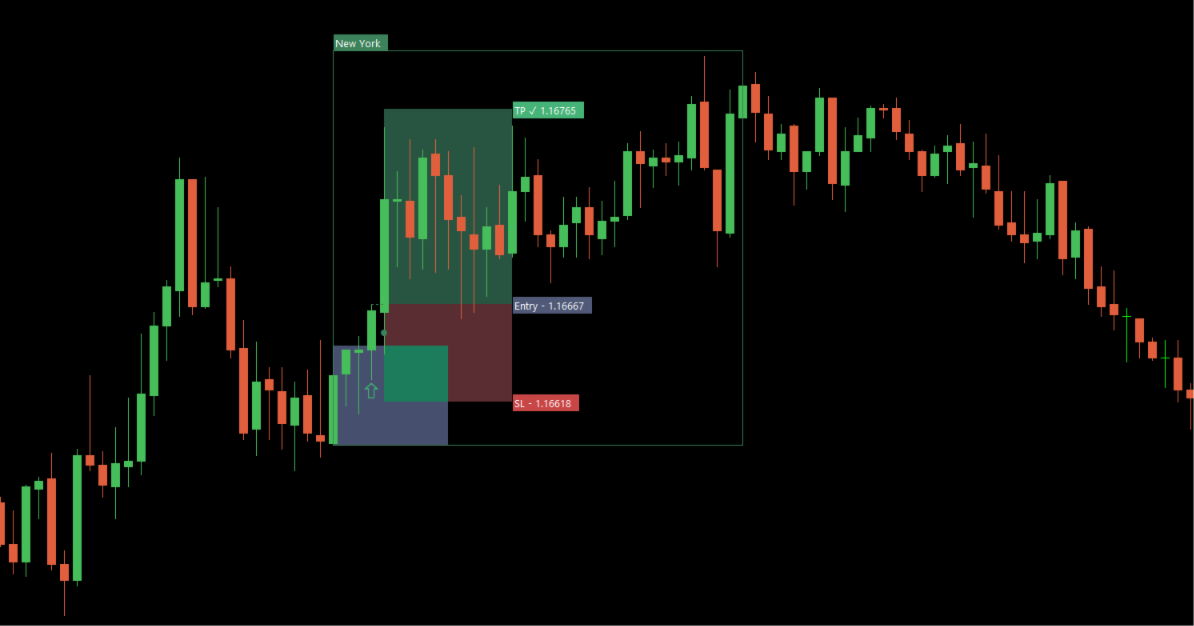
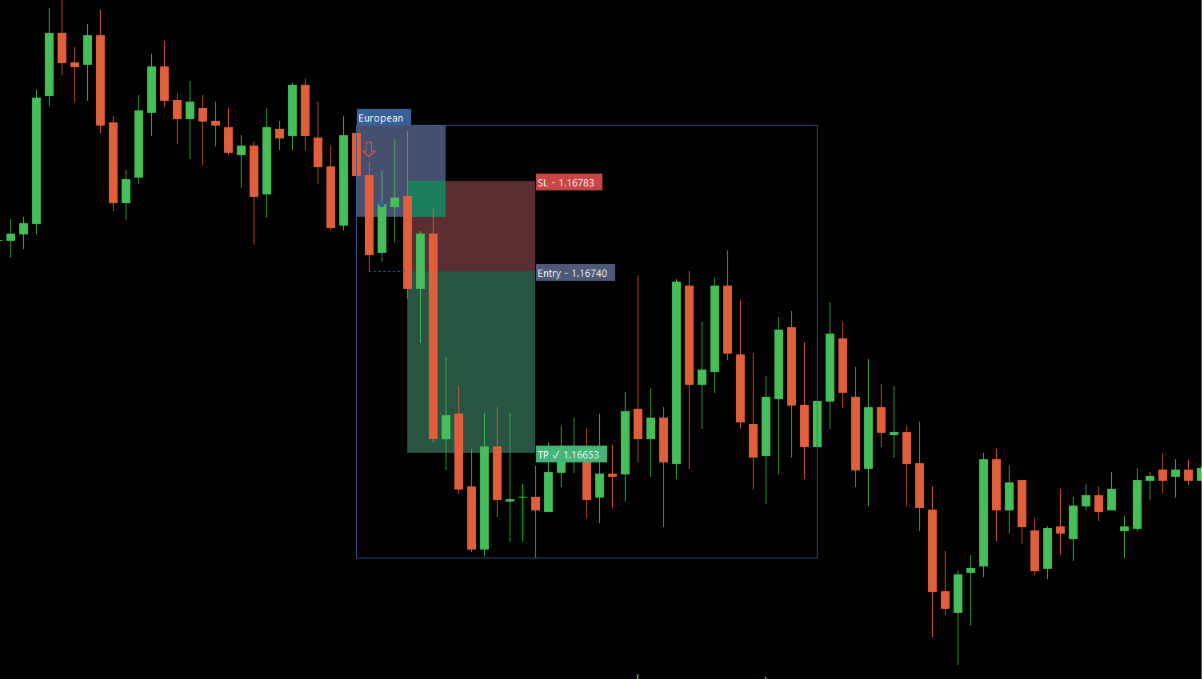
Session DR Boxes The London session (09:00 to 18:00 server time) and New York session (15:00 to 23:00 server time) are each drawn as outlined boxes with a session name label. These define the dealing range within which the indicator monitors for MSB confirmation. Both sessions run simultaneously and are tracked independently, so a London setup and an NY setup can coexist on the same chart without conflict.
Opening Range Box The first candle of each session establishes the ORB — the initial price range the indicator monitors for liquidity engineering. The high and low of this candle define the premium and discount boundaries of the DR. The box closes at the MSB candle and extends a configurable number of bars past it, keeping the broken PDH or PDL equivalent level visible during the retracement phase.
MSB Arrow The first candle to close beyond the ORB range confirms the MSB. A bullish MSB prints a green arrow; a bearish MSB prints a red arrow. This is the point at which the setup becomes active and the indicator begins monitoring for DR level mitigation. If the MSB closes through the opposite side of the DR in the same direction as the sweep, the setup does not form — that day counts as a standard impulse rather than an ORB setup.
Breaker Level Line Between the MSB candle and the mitigation of the ORB level, price typically forms an impulse leg with a defined extreme — the swing high in a bearish setup (BSL swept) or the swing low in a bullish setup (SSL swept). This extreme, the breaker or order block reference, becomes the pending order entry level. The indicator draws a dotted line at this price from the MSB candle onward. Once the RR zone is drawn, the line terminates at the zone's left edge so it never overlaps the trade area.
Mitigation Dot When price retraces and touches the broken ORB level — mitigating that DR boundary — a dot is placed on the chart. This confirms that price has returned to the POI and that the pending limit order is now in play. The dot is suppressed on invalidated setups to avoid visual confusion with adjacent session boxes.
Pending Limit Order Zone Once price closes beyond the breaker level, the indicator arms a pending limit order at that price and draws an entry zone. Unlike a market order or a BOS stop entry, the limit order requires price to retrace back to the breaker — a core ICT principle that keeps the entry inside a valid FTA (first touch area) rather than at the point of expansion. This is what produces clean RR on every qualified setup.
RR Zones On fill, two filled rectangles are drawn from the signal bar — a risk zone in red from the entry to the SL, and a reward zone in green from the entry to the TP. The SL can be calculated from the high or low of the entry candle (entry candle method) or from an ATR-based distance with a configurable multiplier and pip buffer. The TP is set by your RR ratio input. Both labels carry a tick mark when the respective level is hit.
Invalidation If price closes through the opposite side of the ORB DR before the order fills, the entire setup is invalidated. All drawings turn grey and remain on chart for post-session review, but no further logic runs for that session day. This mirrors the SMC principle that a close through the opposite DR boundary signals that the liquidity on that side has been consumed via a stop hunt, and the original OF thesis is no longer valid.
Order Expiry If price does not return to the FTA entry level within a configurable number of ORB-TF bars after the order is armed, the order is cancelled. A "No Entry (Cancelled)" label replaces the entry zone. No SL or TP zones are drawn, and the setup closes cleanly.
Inputs
Display
| Input | Default | Description |
|---|---|---|
| Opening range timeframe (ORB-TF) | M15 | The TF on which the ORB candle and MSB logic are calculated. Independent of the chart TF — e.g. M15 ORB on an H1 chart. |
| Days of history to show | 30 | Number of trading days drawn on the chart. |
| Hide chart grid | Yes | Removes the background grid for a cleaner view. Restored on removal. |
| Apply candle colours | Yes | Sets institutional-style candle colours. Restored on removal. |
| Show session DR box | Yes | Draws the session dealing range box. |
| Show ORB box | Yes | Draws the opening range box on the first candle of the session. |
| Extend ORB box past MSB (bars) | 5 | Bars past the MSB candle that the ORB box continues. |
| Breaker level line length (bars) | 10 | Length of the dotted FTA / breaker level line. |
| Cancel unfilled order after (bars) | 10 | Expiry window for the pending limit order, in ORB-TF bars. |
Risk
| Input | Default | Description |
|---|---|---|
| SL method | ATR based | Entry candle high/low or ATR-based distance. |
| SL buffer (pips) | 1.0 | Additional buffer beyond the calculated SL. Prevents SL from sitting directly on the liquidity pool. |
| ATR period | 14 | Lookback period for the ATR. |
| ATR multiplier | 1.0 | Scales the ATR distance. Increase for volatile instruments or wide-range IPDA data ranges. |
| RR ratio | 2.0 | Sets the TP distance relative to the SL. Default 1:2 RR. |
Alerts
| Input | Default | Description |
|---|---|---|
| Popup alert with sound | Yes | MT5 popup and audio alert. |
| Push notification | Yes | Push to the MT5 mobile app. Requires MetaQuotes ID in Terminal settings. |
| Alert on MSB / setup | Yes | Fires when the MSB arrow is drawn. |
| Alert on fill | Yes | Fires when price touches the FTA entry level. |
| Alert on cancel | Yes | Fires when the order expires. |
| Alert on TP hit | Yes | Fires when the TP is reached. |
| Alert on SL hit | Yes | Fires when the SL is reached. |
Sessions
| Input | London Default | NY Default | Description |
|---|---|---|---|
| Enabled | Yes | Yes | Enable or disable the session DR. |
| Name | European | New York | Label shown on the DR box. |
| Start | 09:00 | 15:00 | Session open in broker server time. |
| End | 18:00 | 23:00 | Session close in broker server time. |
Recommended Use
The indicator is best suited to the London open, the NY open, and the London-NY overlap sessions on liquid pairs — EURUSD, EURAUD, AUDUSD — and on spot XAU/USD and XAG/USD. The default M15 ORB-TF works well on H1 and H4 charts, providing HTF DR context while keeping entry precision on the LTF.
ATR-based SL with a multiplier of 1.0 to 1.5 suits most major pairs during a standard ADR day. On high-impact news days or wide IPDA range sessions, a multiplier of 1.5 to 2.0 prevents the SL from sitting inside the natural volatility of the session. The 1:2 RR default targets the opposing liquidity pool — the BSL or SSL resting above or below the DR — which aligns with standard ICT TP methodology.
Session times should be entered in broker server time. The London session defaults cover the full London open through to the Frankfurt PM close. The NY session defaults cover the NY open through to the late afternoon liquidity window that precedes the Asian range formation.
Opening Range Breakout — MQL5 Marketplace