Impervyx US100

Impervyx US100

H1 impulse. One long position. Explicit exposure limits.

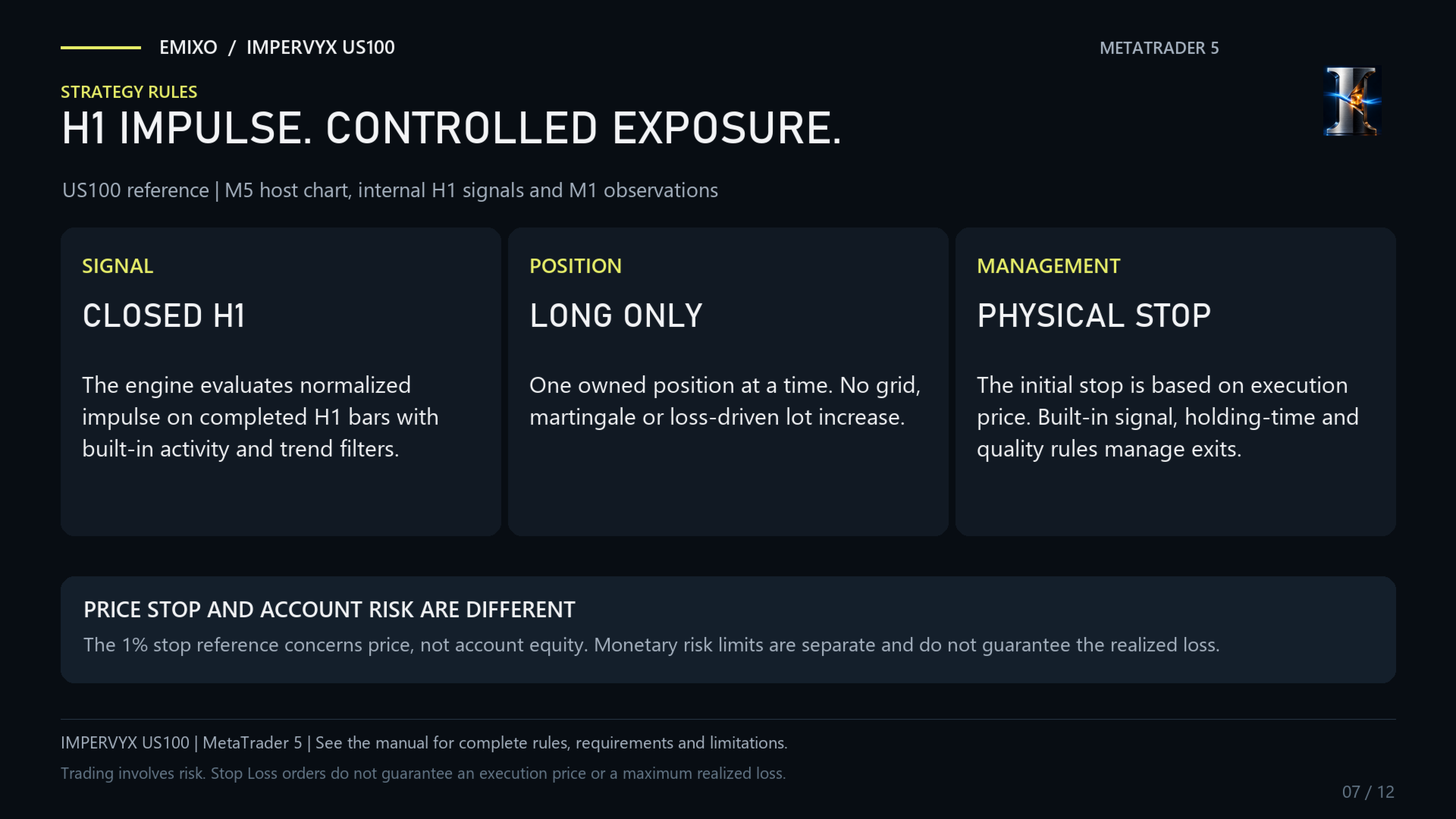
IMPERVYX follows a normalized-impulse model on the Nasdaq, using closed H1 bars and activity, direction and average filters. It combines entry selection with a physical stop and management of its own trading book.

The trading approach

The engine evaluates a completed H1 signal, uses M1 observations and maintains one owned long position. Management includes internal exits, a maximum holding-time rule and data-quality checks. The host chart's timeframe does not change the internal signal period.

What Impervyx offers

  • Completed-data signals. H1 decisions follow a defined operating sequence.
  • Identifiable exposure. One owned position, without grid, martingale or loss-driven lot increases.
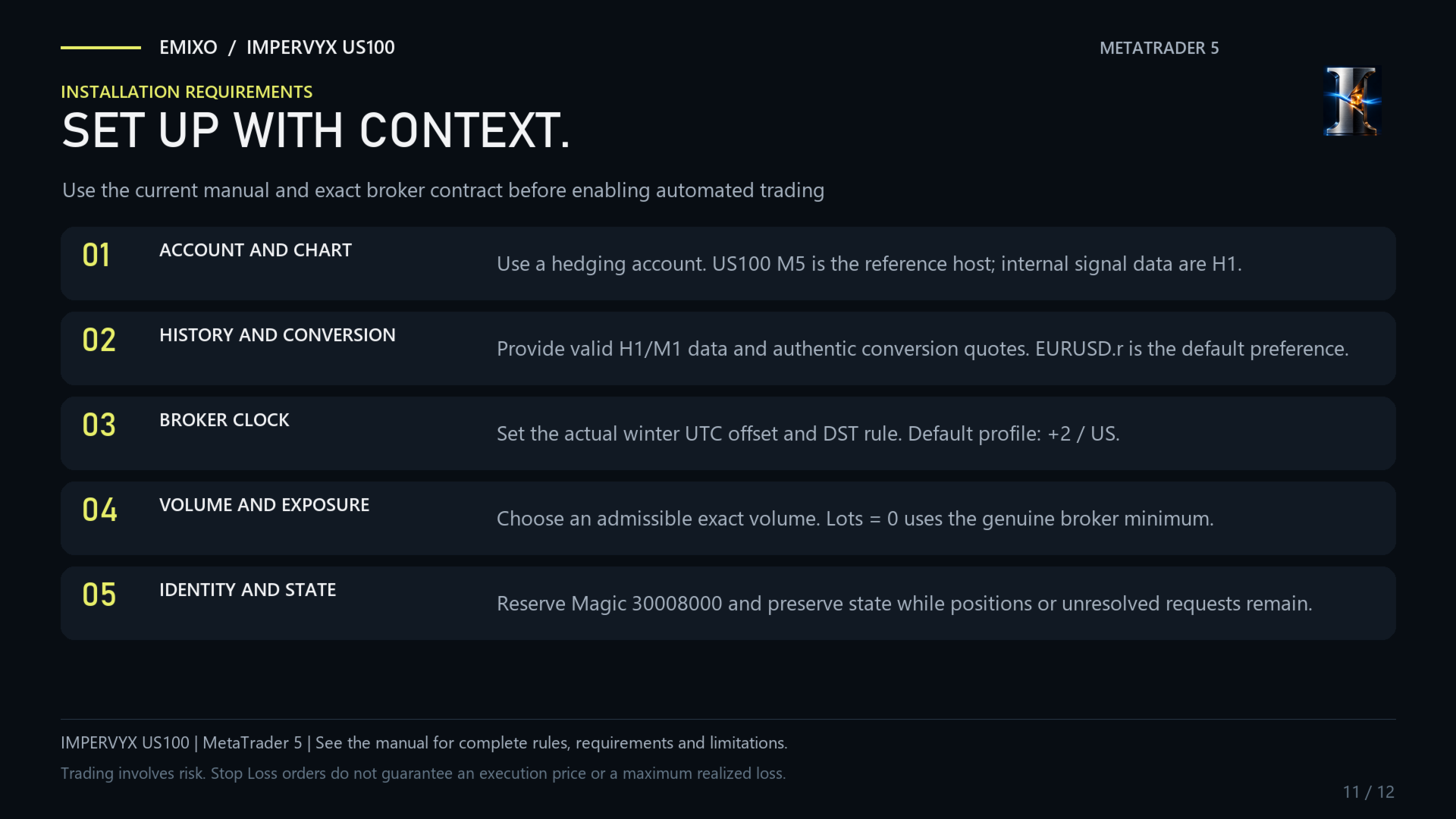
  • Precise volume selection. Use the broker's genuine minimum or request an exact positive volume.
  • A separate own book. The engine follows its own results and preserves operating obligations across restarts.

Your settings

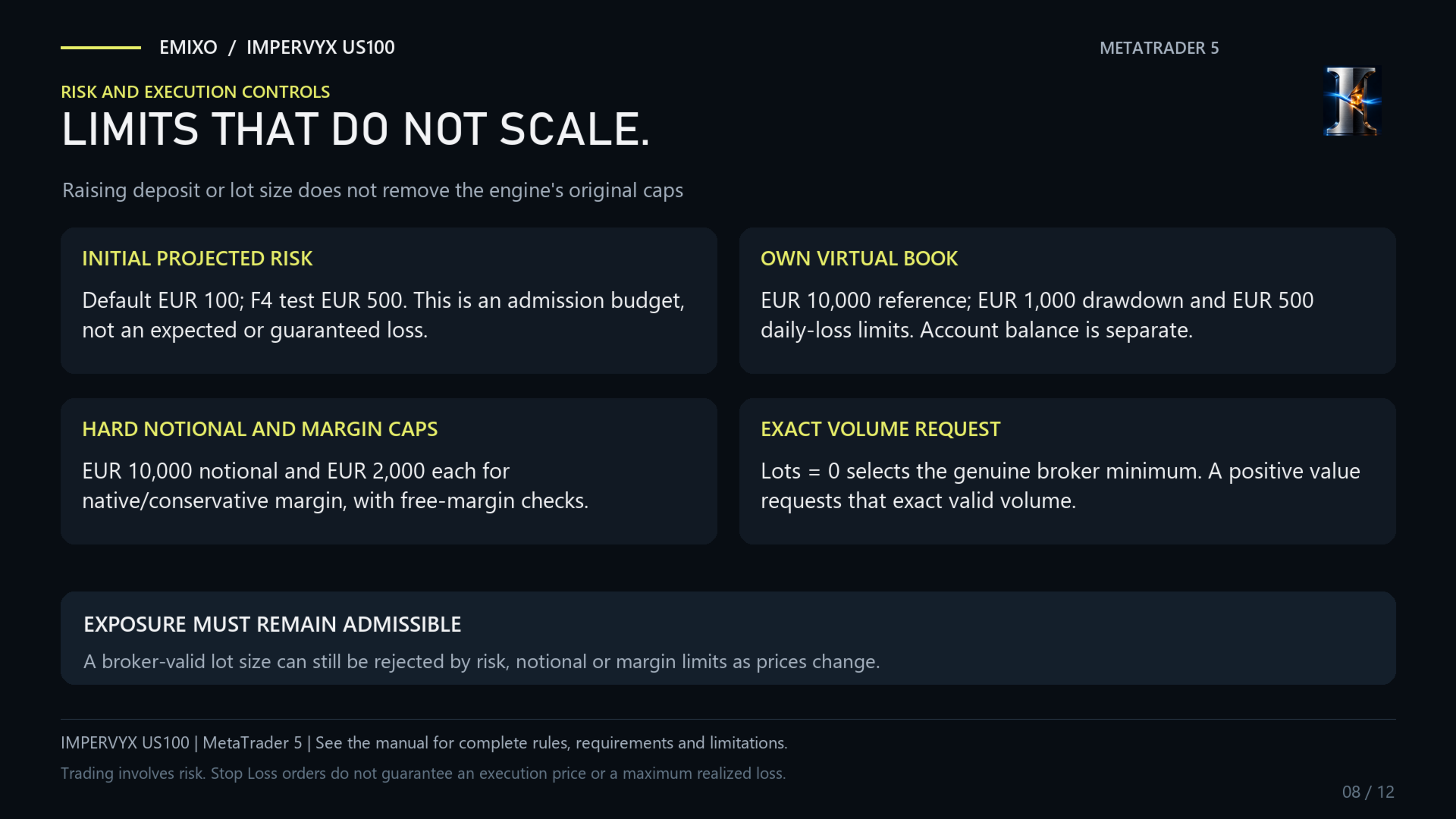
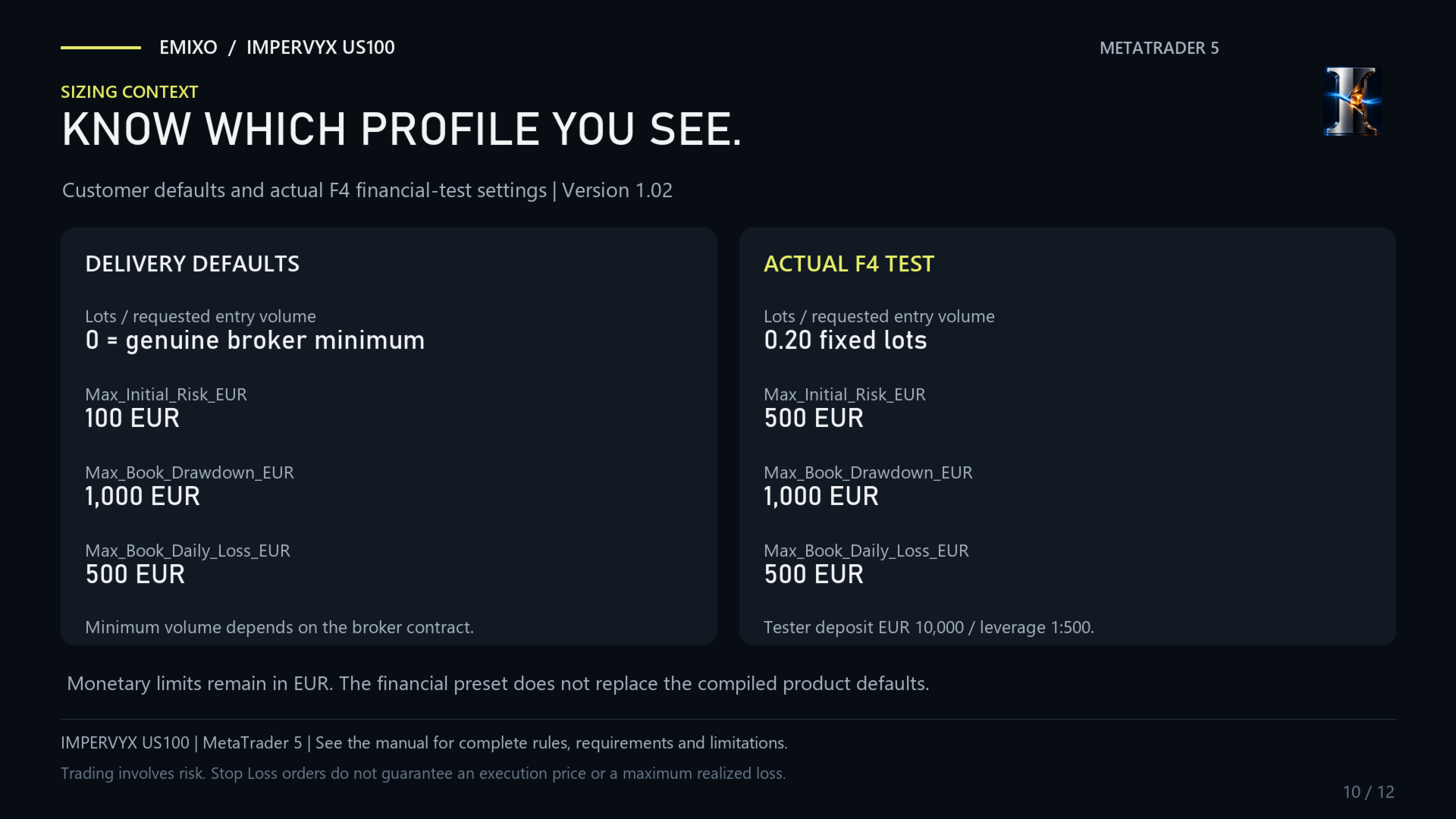
Lots=0 selects the broker minimum, with a default initial budget of EUR 100. The own book keeps a EUR 10,000 reference, EUR 1,000 drawdown limit and EUR 500 daily-loss limit. Separate internal caps remain EUR 10,000 notional and EUR 2,000 for each specified margin measure; increasing the deposit does not automatically raise them.

Reference setup

Use MetaTrader 5 with a hedging account and your broker's actual US100 contract. M5 is the reference host chart, while H1 is the signal period. Configure EUR conversion and the broker clock as described in the manual.

Historical test

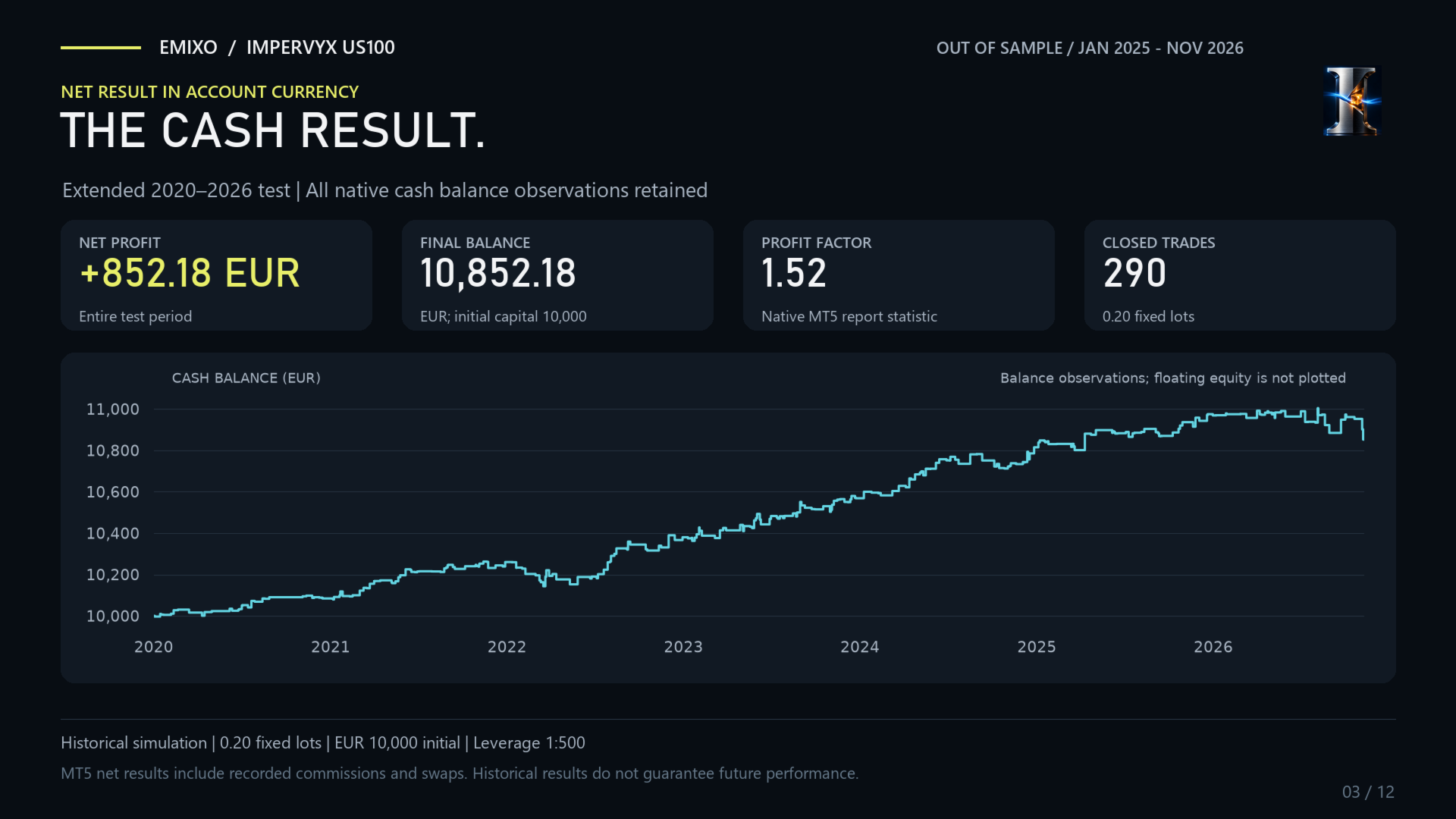
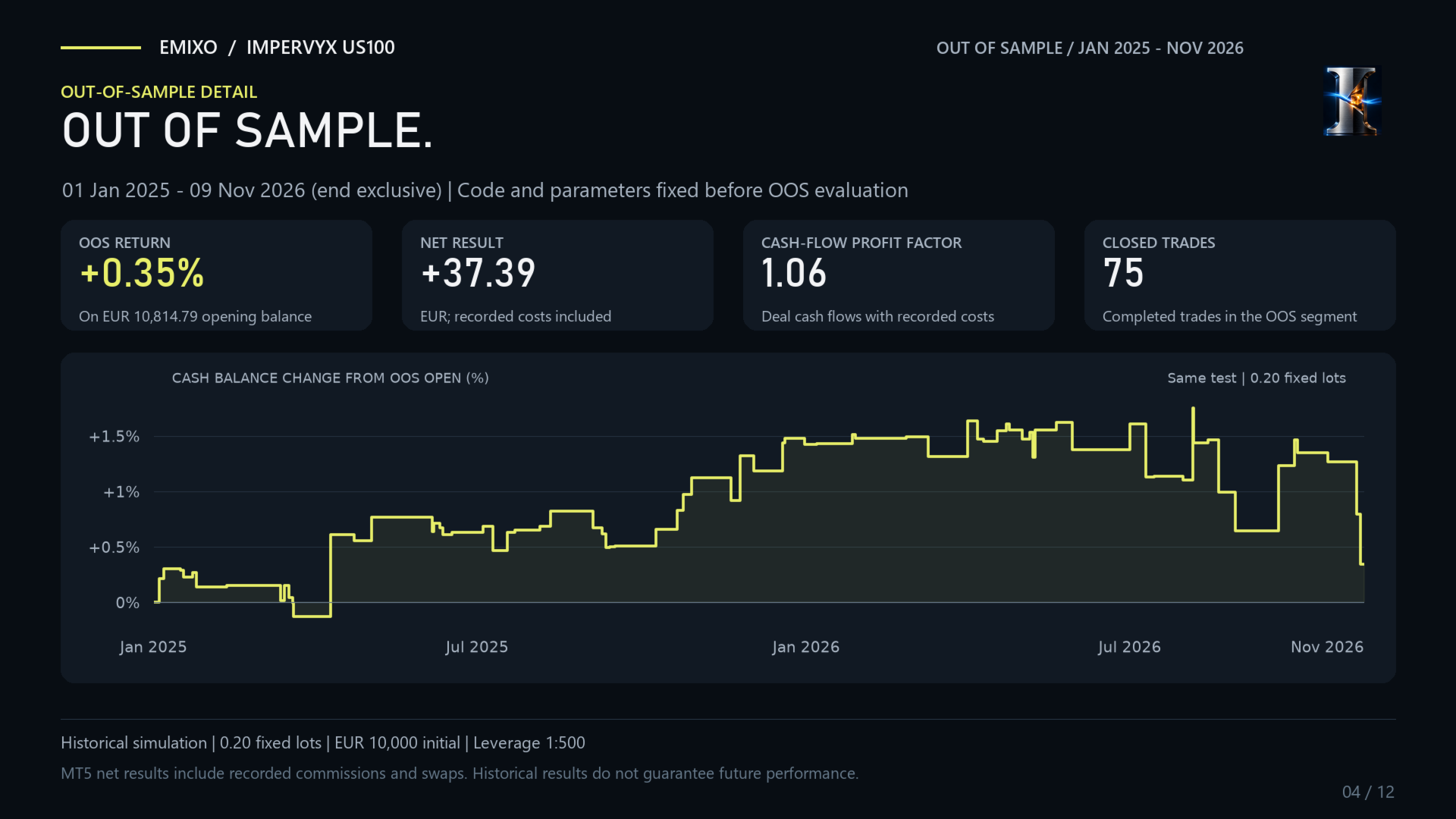
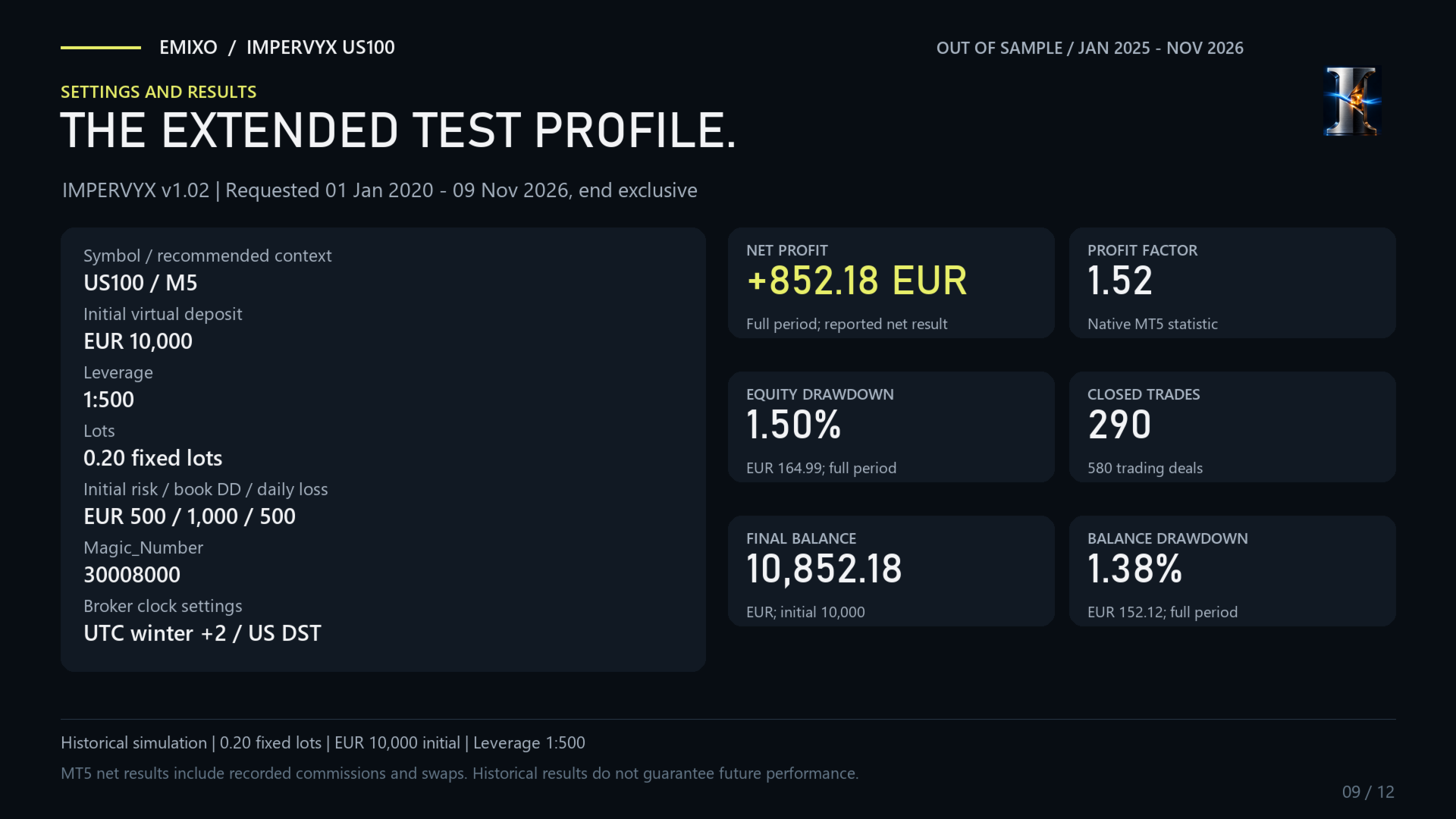
US100, 01 Jan 2020 – 09 Nov 2026 (end exclusive). Initial virtual capital EUR 10,000, leverage 1:500.

  • Net result: +EUR 852.18.
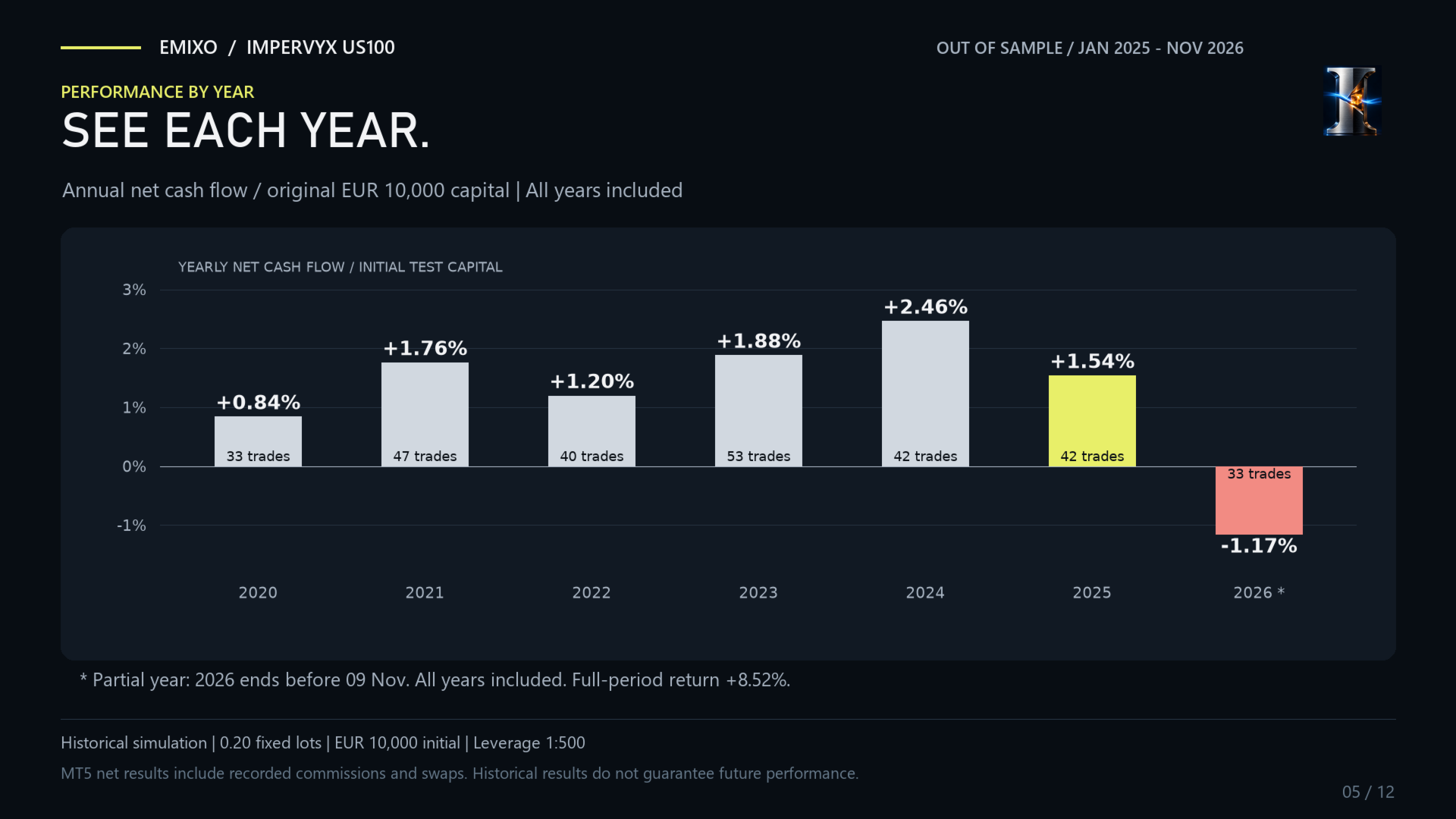
  • Full-period return: +8.52%, not annualized.
  • Profit Factor / closed trades: 1.52 / 290.
  • Maximum relative equity drawdown: 1.50%.

Test profile: 0.20 lots and EUR 500 initial budget; defaults broker minimum and EUR 100 budget. Net figures include commission and swap recorded in the report. The historical profile is separate from the product's starting settings.

Getting started

Use the Market demo in the Strategy Tester to examine entries and exits with your broker's data. Before operational use, check the configuration on a demo account. For setup questions, contact the seller through MQL5 messages or product comments.

Trading involves a risk of loss. Backtests are historical simulations, not live results or forecasts. Spreads, costs and execution can change outcomes; stops and operating limits do not guarantee a maximum loss.
More from author
Meridian EURUSD Price bands, position management and four essential controls. MERIDIAN brings an integrated entry and exit strategy to EURUSD H1. It evaluates price conditions, waits for its signal and manages trades automatically, while you choose the trade size and configure the operating environment. The trading approach Entries use price-band conditions. Trade management combines Stop Loss and Take Profit with volatility, moving-average and opposite-signal exits. Decisions are evaluated at
Orvanthys US100 The US open. A thirty-minute range. An M5 confirmation. ORVANTHYS applies Opening Range logic to US100. It builds the initial US cash-session range and looks for a long entry on the method's first qualifying confirmation, with a defined stop, target and intraday exit. The trading approach The engine records the first 30 minutes' high and low. The range must meet the 0.85% opening-price limit, and entry requires the first closed M5 candle above its high. The initial stop is at th
Tridovyx USDJPY Three daily candles. Two independent directions. Broker-side orders. TRIDOVYX builds its trading plan from three completed D1 candles. When the pattern qualifies, it prepares both directions around the previous day's prices using real broker Buy Stop and Sell Stop orders. The trading approach The pattern requires a bullish candle followed by two bearish candles or dojis. The Buy Stop is placed above the previous D1 high and the Sell Stop below its low. Each direction has a physic
Causoryx US100 A price oscillator, the US opening window and defined M10 rules. CAUSORYX looks for directional signals during the US opening window. It combines a normalized oscillator with completed M10 bars, fixed volume and a configurable initial-risk budget. The trading approach The model measures the distance from an exponential average relative to ATR, then smooths completed-bar values. Positive and negative threshold crossings generate the signals. On the strategy's reference clock, M10 d
Aurvexyn US100 Two H1 modules, distinct management and defined Nasdaq weights. AURVEXYN brings two US100 modules together in one Expert Advisor. A shared signal family is paired with two management approaches, an explicit volume ratio and a single configurable scale. The trading approach Both modules use the internal H1 timeframe while retaining their own signals and entry checks. The weights are 5:7: a base of 0.01 produces nominal volumes of 0.05 and 0.07 lots. Each module manages its own trad
Pentaryx AUDCAD Five modules. One Expert Advisor. One volume scale. PENTARYX combines five trading modules in one Expert Advisor for AUDCAD. Its defined weighting structure lets you manage the collection from a single chart instead of configuring five separate programs. The trading approach Each module retains its own method and internal timeframes. The weights are 1:1:1:2:2: the first three modules use the base volume, while the last two use twice that amount. Entry_Amount changes the volume sc
Kairovyx GBPJPY Tokyo's 09:55 reference, a calendar and a scheduled exit. KAIROVYX applies a time-based reversal strategy to GBPJPY around 09:55 Tokyo time. Its built-in calendar identifies trading dates; the engine evaluates a short entry within the specified window and manages the stop and scheduled closure. The trading approach On scheduled dates, entry is considered in the first minute of the 09:55 JST window. Closure is scheduled 25 minutes after the event reference unless the stop acts ea
Vexaprism US100 Cash-session levels. Intraday confirmation. Calculated position size. VEXAPRISM turns the previous US cash session's levels into a US100 trading plan. The strategy compares price with R1 and S1, looks for confirmation at its scheduled time and calculates volume from reference capital and the stop. The trading approach Levels are built from the previous cash session's M1 data. At 18:30 on the New York+7 reference clock, the engine evaluates a buy above R1 or a sell below S1. The i
Reclyth US100 Daily weakness, a recovery level and US-session management. RECLYTH looks for an intraday recovery after daily weakness. The strategy combines the context of completed D1 closes with an entry level calculated from the last three sessions, taking long positions on US100. The trading approach The last D1 close must be below the simple average of the last 40 closes. Amplitude A is derived from the last three D1 bars and added to the previous close to establish the recovery level. The
Enveloryx GBPAUD An Envelopes crossing and a Stochastic turn on H1. ENVELORYX combines two technical conditions in one GBPAUD H1 model. The engine waits for alignment between a band crossing and a change in Stochastic direction, then manages the trade using built-in exit rules. The trading approach Stochastic uses settings 47, 9 and 21, while Envelopes uses 76 periods and 0.62% deviation. Conditions are evaluated at the opening of a new H1 candle. Exits can follow an opposite signal, the sequenc
Filter:
No reviews
Reply to review