Discussing the article: "MQL5 Wizard Techniques you should know (Part 84): Using Patterns of Stochastic Oscillator and the FrAMA - Conclusion"
Hello Stephen,
A very interesting article, especially Pattern 0.
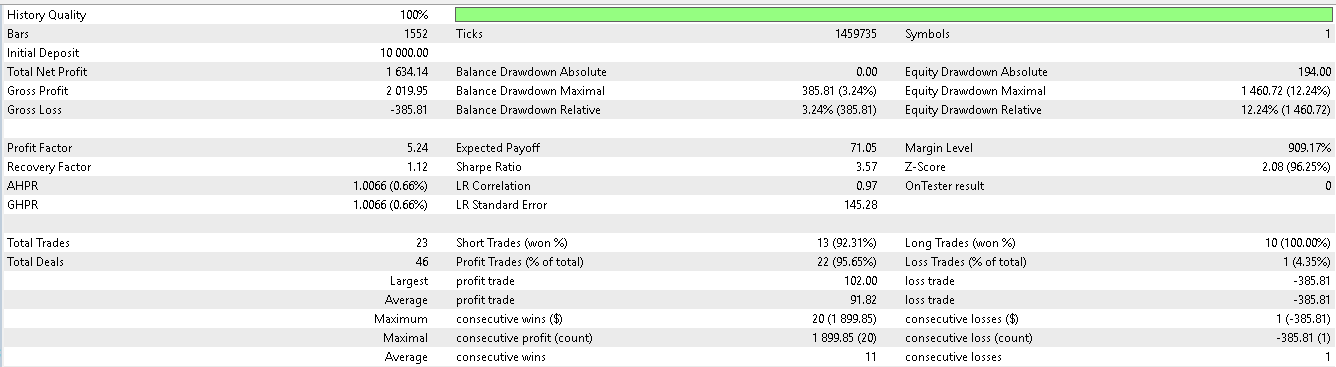
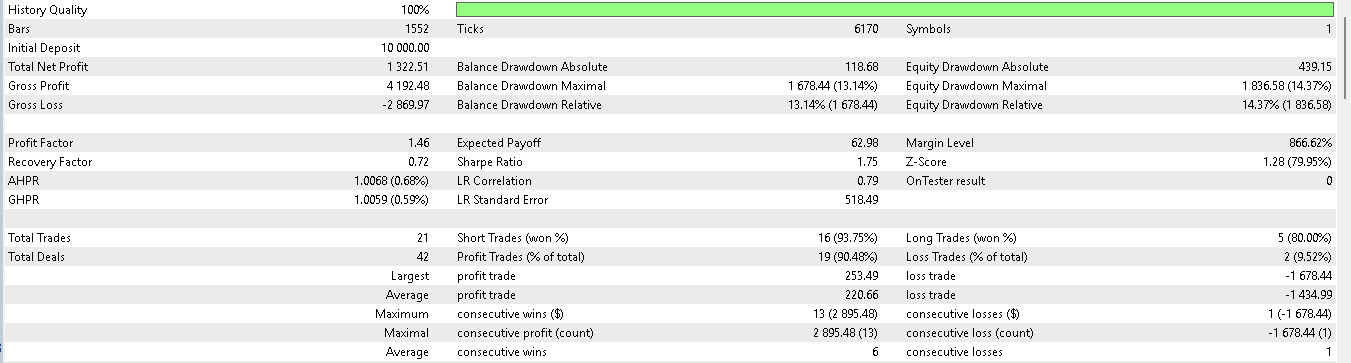
I downloaded your code from the prior article, compiled and ran it on four Major USD currencies, EUR, GBP, CAD, JPY for the H4 timeframe and for the period 1/1/25 - 10/1/25 and ALL produced a loss.
First of all, do I have to retrain it for the specific currency, and secondly, how do I specify using only one or several of the patterns? Also, can this ea be used to incorporate several of your excellent articles?
Thanks,
CapeCoddah
In my view, it is important to distinguish between two things here.
The test covering the period from 1 to 10 January is too short to assess the strategy’s consistency. On the H4 timeframe, this is a very small sample, and the result over just a few trading days can be heavily influenced by specific market conditions.
At the same time, however, the question arises as to whether the results presented in the article can be replicated.
It is stated that training was carried out on one year’s data, whilst validation was carried out on the following year’s data, with appropriate assets selected for different market archetypes. Therefore, it is not enough simply to run the source code on EUR, GBP, CAD and JPY with arbitrary or standard settings.
For independent verification, it is advisable to specify the following for each pattern:
— the exact symbol;
— timeframe;
— the training period;
— the validation period;
— the full set of input parameters;
— optimisation criterion;
— spread, commission and simulation mode;
— which specific patterns were included;
— whether different parameters were used for each instrument.
It is also useful to explain the technical mechanism for selecting patterns. Are they enabled via separate input switches, a bit mask or signal weights, or is each pattern implemented as a separate class?
As for combining several strategies within a single expert advisor, this is architecturally possible, but it is necessary to define not only how the modules are connected, but also the rules governing their interaction:
— how signals are aggregated;
— what to do in the event of conflicting signals;
— which module takes priority;
— whether weights are used;
— whether one pattern can filter out another;
— how overall risk management limits aggregate positions.
Therefore, the main question for the author is: could you publish the exact configuration for at least one of the forward-test results shown, so that another user can reproduce it without any hidden assumptions?
Hello,
Just seeing this. It may depend on the broker data you are using.
As always, past performance does not guarantee future results and this is not Financial advice.
Files:

You are missing trading opportunities:
- Free trading apps
- Over 8,000 signals for copying
- Economic news for exploring financial markets
Registration
Log in
You agree to website policy and terms of use
If you do not have an account, please register
Check out the new article: MQL5 Wizard Techniques you should know (Part 84): Using Patterns of Stochastic Oscillator and the FrAMA - Conclusion.
The Stochastic Oscillator and the Fractal Adaptive Moving Average are an indicator pairing that could be used for their ability to compliment each other within an MQL5 Expert Advisor. We introduced this pairing in the last article, and now look to wrap up by considering its 5 last signal patterns. In exploring this, as always, we use the MQL5 wizard to build and test out their potential.
From the last article, we examined the first 5 signal patterns of the Indicator pairing Stochastic-Oscillator and Fractal Adapting Moving Average. From our small test window, all appeared to have profitable forward walks, with training done over a year and the validation performed over the subsequent year.
We performed these tests while being mindful of the patterns’ suitable market types, whilst also using ‘appropriate’ assets for each market type. The market archetypes we considered were trending/mean-reverting, auto-correlated/decoupled, and highly-volatile/low-volatility markets. Within these types we tried to attribute particular asset types that are better exploited by these patterns, and based on the forward results, our selection could have been appropriate.
We therefore maintain the same asset-type/market-archetype pairing of the last article as we consider the remaining 5 signal patterns of this indicator pairing.
Author: Stephen Njuki