Christopher Manalang / Profil

- Information
|
2 Jahre
Erfahrung
|
1
Produkte
|
23
Demoversionen
|
|
0
Jobs
|
1
Signale
|
0
Abonnenten
|
ich bin Christopher, Entwickler und aktives Mitglied der MQL5 Community. Ich entwickle leidenschaftlich gerne effektive Trading-Lösungen und leiste meinen Beitrag zu dieser großartigen Plattform.
Meine Programme finden Sie im Market. Ich bin der Meinung, dass der beste Weg, ein Tool zu bewerten, darin besteht, es selbst auszuprobieren. Laden Sie daher gerne die Demoversionen meiner Produkte herunter. Bisher wurden meine Produkte bereits von mehreren Nutzern für Demotests heruntergeladen.
Als Nutzer der Plattform trage ich auch selbst bei, indem ich über den Service Desk Feedback zu Problemen gebe und die Diskussionen im Forum verfolge. Ich glaube, dass klare Kommunikation und qualitativ hochwertige Produkte die Schlüssel zum Erfolg sind.
Lassen Sie uns in Kontakt treten! Weitere Informationen finden Sie in meinem Profil.


https://a.co/d/4TtpMT6
If you're frustrated, on the brink of giving up, and feel like you're stuck in the 95% of losing traders, it's not your fault. You've been taught to trade like a gambler. This book will teach you to win by building a business.
"Trade for a Living: The Forex Business Plan" is not another trading strategy book—it's a revolutionary, step-by-step guide to transforming your trading from a losing hobby into a profitable, fully automated enterprise.
In this intensive, hands-on workshop, you will fire yourself as an emotional "trader" and promote yourself to the role of a calm, data-driven Chief Executive Officer (CEO) of your own financial firm.
This is a book of actions, not just theories. You will learn to:
Master the CEO Mindset: Adopt the patient, data-driven perspective that separates the winning 5% from the rest.
Execute the 3-Year Plan: A realistic blueprint for your first year of survival, your second year of growth, and your third year of sustainable income.
Conduct a Professional Feasibility Study: In our click-by-click workshop, you will download a demo Expert Advisor (EA) and use backtesting to scientifically validate its statistical edge. You will learn the skills of a quantitative analyst.
Build a Formal Business Plan: Analyze four distinct, professionally vetted business models—from conservative to aggressive—and create a complete financial plan, from startup capital to your risk management protocol.
Assemble Your Infrastructure: Learn to select a top-tier broker and set up a 24/7, institutional-grade trading operation with a Virtual Private Server (VPS).
By the end of this guide, you will possess a complete business plan, a fully operational infrastructure, and the skills to build a real, lasting source of algorithmic wealth.
If you are ready to stop chasing signals and start building a legacy with a proven, step-by-step blueprint, this is the last trading book you will ever need.
https://a.co/d/4TtpMT6
Introduction: The CEO Mindset in a World of Gamblers
The flickering lights of the forex market never sleep. From the bustling financial hubs of New York and London to the vibrant centers of Tokyo and anywhere in the world, trillions of dollars exchange hands every single day in a relentless, digital dance. For the vast majority of participants, this dance is a fleeting affair, a casual hobby, a thrilling side hustle, or, all too often, a high-stakes gamble fueled by hope and hype. They are the tourists in a world of professionals, drawn in by the promise of fast money, only to find their accounts depleted and their dreams dashed against the rocks of market reality.
They fail not because the market is rigged, or because they lacked a "holy grail" indicator, but because they fundamentally misunderstood the nature of the endeavor.
They treated trading as a game.
This book is not for them.
This book is for the aspiring professional. It is for the individual who looks at the charts and sees not a casino, but a global marketplace of immense opportunity. It is for the person who is ready to stop gambling and start building a business. Welcome to the CEO Mindset. Welcome to the EA
Business Model.
For the next several chapters, we will embark on a transformative journey. We will strip away the layers of amateurism that plague 90% of retail traders and replace them with the principles, structures, and disciplines of a successful business enterprise. We will teach you how to shift your identity from "trader" to "Chief Executive Officer" of your own financial company, which we will call "You, Inc."
The product your company deals in is capital appreciation. Your business activity is the strategic buying and selling of financial instruments, in our case, currency pairs. And your primary asset, the engine of your entire operation, is your team of automated trading systems, your Expert Advisors (EAs).
Your Expert Advisor is Not a Tool; It's Your Sales Team
Let’s begin with the most crucial paradigm shift. Most traders view an Expert Advisor as a piece of software, a tool they purchase and deploy. This is a limited and ultimately flawed perspective. A hammer is a tool; a spreadsheet is a tool. An EA, when properly integrated into a business framework, is far more than that.
Your EA is your 24/7, tirelessly working, globally-deployed sales force.
Think about it. In a traditional business, the sales team is responsible for generating revenue. They execute the company's strategy in the marketplace, seeking opportunities to buy low and sell high (or sell high and buy low). They operate based on a set of rules, training, and strategic direction provided by the management (that's you, the CEO). They do not get tired. They do not get emotional after a lost sale. They do not deviate from the playbook out of fear or greed. Their job is singular in purpose: to execute the business plan and generate profit.
This is precisely the role of a well-vetted Expert Advisor. It is your employee. It works the morning shift in London, the afternoon shift in New York, and the graveyard shift in Sydney, all without demanding overtime. Its sole function is to scan the market for opportunities that fit the precise strategic parameters you have defined and to execute trades—your "sales"—flawlessly.
When you begin to see your EA not as a magic black box but as a highly specialized employee, your entire approach to trading will change. You will stop asking, "Will this EA make me rich?" and start asking the questions a real CEO would ask:
"What is this employee's performance record?" (Backtesting and forward testing)
"What are its strengths and weaknesses?" (Strategy analysis)
"Under what market conditions does it perform best?" (Operating environment)
"What is its risk profile? Is it a conservative, steady performer or a high-risk, high-reward 'star' salesperson?" (Risk management analysis)
"What is its cost to the company?" (The 'salary' and overhead)
This is the foundation of the EA Business Model. You are no longer a passive user of a tool; you are the active manager of a high-performance team.
The CEO's Prerogative: Why EAs Outperform Signals for a Business
At this point, a valid question arises: "If the goal is to leverage the expertise of others, why not simply copy a successful human trader through a signal service?" While signal services can seem appealing, from a business owner's perspective, they represent an unacceptable abdication of control, transparency, and strategic oversight. A CEO would never build their company on such a fragile and unpredictable foundation.
Subscribing to a signal is not like hiring a salesperson; it's like blindly funding a freelancer you've never met, who refuses to share their strategy, and who might change their entire work ethic tomorrow based on their mood. An Expert Advisor, by contrast, is a fully vetted employee whose entire methodology is transparent and quantifiable. Let’s break down the critical business advantages of an EA-centric model.
1. Control vs. Dependency
The EA Model (You are the CEO): With an Expert Advisor, you are in absolute control. You own the strategy. You set every parameter, from the lot size and risk-reward ratios to the specific hours of operation. You decide which markets it will trade and when to deploy it. You are the manager of a system.
The Signal Model (You are a Follower): When you copy a signal, you are completely dependent on the decisions of another human being. You are a passenger in their car, and you have no access to the steering wheel, the brakes, or the map. The signal provider could be having a bad day, they could be revenge trading after a loss, or they could simply decide to go on vacation for a month. Your business's revenue is entirely subject to their whims and psychological state.
2. Due Diligence vs. Blind Faith
The EA Model (Predictive Analysis): An EA's strategy is encoded in logic. This gives you, the CEO, a superpower: the ability to perform rigorous due diligence through backtesting. You can run your "employee" through years of historical market data to create a detailed statistical profile of its expected performance. You can analyze its probable drawdown, its profit factor, and its win rate across thousands of simulated trades. This is the ultimate predictive analysis—a data-driven forecast of your revenue engine's capabilities.
The Signal Model (Past Performance Fallacy): With a signal provider, you cannot perform predictive analysis. You can only look at their past performance, which, as every disclaimer states, is no guarantee of future results. You are placing your faith in a curated track record with no insight into the underlying process. Was their recent success due to a repeatable strategy, or was it a lucky streak? You have no way of knowing. You cannot backtest a human.
3. Systematic vs. Discretionary
The EA Model (Repeatable Process): A successful business is built on systematic, repeatable processes. An EA is the embodiment of this principle. It executes its coded strategy with robotic precision, free from fear, greed, or hesitation. It mechanically applies the same proven logic day in and day out.
The Signal Model (Unpredictable Human Element): The signal provider is discretionary. Even if they claim to follow a system, their execution is subject to human error and emotion. They might miss a trade because they were away from their desk, or they might violate their own rules in a moment of panic. This unpredictability is poison to a business that requires stable, consistent operations.
4. Scalability and Diversification
The EA Model (Building a Team): A true business scales by building a diversified team. As a CEO, you can deploy a portfolio of different EAs, each with a unique, uncorrelated strategy, across various currency pairs and timeframes. One EA might be your "conservative performer" on EURUSD, while another is your "aggressive specialist" on Gold. This diversification of your "sales force" creates a more stable and robust revenue stream, smoothing out the equity curve.
The Signal Model (Operational Chaos): Trying to diversify by following multiple signal providers is an operational nightmare. You would be subject to the unpredictable schedules, risk appetites, and overlapping trades of several different human traders, making portfolio-level risk management nearly impossible.
Choosing an EA-based model is the first and most critical executive decision you will make. It is a declaration that you are building a business based on systems, data, and control—not a speculative venture based on hope and dependency.
Building Your Business Infrastructure: The Cost of Doing Business
Every legitimate business has operating expenses. A restaurant has rent, ingredients, and staff costs. A software company has server costs, developer salaries, and marketing budgets. Your trading business is no different. One of the most common reasons retail traders fail is that they only consider their trading capital and ignore the essential overhead required to operate professionally.
Let's break down the budget for "You, Inc." using this powerful business analogy.
1. Employee Salaries (The Cost of Your EAs)
Your sales team doesn't work for free. To acquire a high-quality Expert Advisor from a reputable source like the MQL5 Market, you must invest. This is not a frivolous expense; it is a capital investment in your primary revenue-generating asset. You might acquire your "salesperson" in a few different ways:
Direct Purchase (Hiring Bonus): Buying an EA for a one-time fee is like paying a signing bonus to a top-tier salesperson. You are paying for their pre-built expertise and proven track record.
Rental/Subscription (Monthly Salary): Many of the best EAs on the MQL5 Market are available on a rental basis. This is perhaps the most direct and powerful analogy. You are paying a monthly "salary" for your EA to perform its duties. This is a fixed, predictable operating expense. If the "salesperson" performs well and generates more profit than their salary, you retain them. If they underperform, you can "fire" them by canceling the subscription. This is pure business logic.
2. Office Space (The VPS Rental)
Your sales team needs a place to work. They require a stable, secure, and always-on environment to execute their tasks without interruption. In the world of automated trading, this "office" is your Virtual Private Server (VPS).
Attempting to run a professional trading business from your home computer is like trying to run a global sales operation from a coffee shop with spotty Wi-Fi. It is unprofessional and destined for failure. A power outage, an internet disconnection, a system crash—any of these can cause your "salesperson" to miss a critical instruction, either failing to close a losing trade or failing to enter a profitable one.
Renting a high-quality, low-latency VPS, such as the one integrated directly into the MetaTrader platform, is a non-negotiable operating expense. The monthly fee for your MQL5 VPS is the "rent" for your prime office space, located right next to the financial markets (your broker's servers) to ensure the fastest possible execution. It is a small price to pay for operational stability and peace of mind.
3. Utilities (The Hidden Necessities)
Every office has utility bills: electricity, water, internet. Your trading business does too, though they are more abstract. These are the costs required to keep the lights on and the data flowing.
Data Feeds & Spreads: While not a direct bill, the spread you pay on every trade is a transactional cost. Think of it as the "electricity" powering each transaction. A business owner always seeks to minimize utility costs without sacrificing quality. Similarly, choosing a broker with tight, competitive spreads is a crucial business decision that directly impacts your bottom line.
Internet Connection: Your own high-speed internet connection at home is a utility cost for your role as CEO, allowing you to monitor your operations and manage your team.
Commission: For some account types, you will pay a commission per trade. This is another transactional utility, a cost of accessing the marketplace.
By accounting for these expenses—EA salaries, office rent, and utilities—you are building a proper Profit and Loss (P&L) statement for your business. Your goal is no longer just to have a winning trade; it is to ensure that your Gross Profit from trading is significantly higher than your total Operating Expenses, resulting in a healthy Net Profit.
This analysis evaluates the "Aggressive Growth Model" of the Fractal Breakout EA, viewing it as a sophisticated system built on three distinct, synergistic pillars: a profitable core strategy, a natural compounding engine, and a controlled loss-recovery mechanism. High-Level Summary
The aggressive mode of the Fractal Breakout EA is not merely a trading strategy; it is a meticulously engineered wealth-compounding system. Its exceptional performance stems from the powerful synergy of three layers. At its foundation lies a proven, profitable fractal breakout logic. Layered on top is a dynamic lot-sizing engine that naturally accelerates profits during winning streaks. The final layer is a capped Martingale function, designed as a powerful, yet controlled, tool to aggressively recover from losses. The inclusion of a maximum multiplier cap is the critical design choice that elevates this model from a pure gamble to a calculated, asymmetric-risk instrument. It offers explosive growth potential while defining and limiting the catastrophic risk inherent in traditional Martingale systems. Deconstruction of the Three Core Pillars
To truly understand the results, we must analyze each component part. Pillar 1: The Profitable Core Engine (Base Strategy)
The entire system is built upon a solid foundation. As demonstrated by the "Conservative Model" backtest (which yielded a 1.80 profit factor on its own), the underlying fractal breakout logic is inherently profitable. It has a positive mathematical expectancy. This is the most crucial element, as no amount of aggressive money management can make a losing strategy successful in the long run. Pillar 2: The Natural Compounding Engine (Dynamic Lot Scaling)
With UseMoneyManagement set to true, the EA employs a dynamic lot-sizing model. This means the trade volume is directly proportional to the account balance.
Function: As the account grows, the base lot size for new trades automatically increases. This creates a natural, organic compounding effect. Impact: Winning streaks become exponentially more profitable. A 10% gain on a $1,000 account is $100, but a 10% gain on a $10,000 account is $1,000. This engine ensures that the EA's "foot is on the gas" during favorable market conditions. Pillar 3: The Controlled Recovery Engine (Capped Martingale)
This is the most aggressive component, designed to aggressively counteract losses.
Function: When a loss occurs, the MartingaleMultiplier (e.g., 2.0) is applied to the next trade's lot size. The Crucial Safeguard: The MaxMultiplier setting (capped at 4.0 in the test) acts as an emergency brake. It dictates that after a certain number of consecutive losses (in this case, two), the risk escalation stops. The multiplier sequence is: 1x → 2x → 4x → 4x → 4x... Impact: This engine's goal is to rapidly recover from drawdowns. The cap is the feature that prevents the infamous Martingale "death spiral," where a long losing streak would otherwise lead to an infinite and unsustainable increase in lot size. It transforms the strategy from one with unlimited risk to one with defined, albeit very high, risk. Synergy: How the Pillars Work Together
The phenomenal 46,262% return is not the result of any single pillar, but of their powerful interaction. The EA enters a winning streak. Pillar 2 (Dynamic Scaling) steadily increases the base lot size as the account grows. The EA then encounters a losing trade. Pillar 3 (Capped Martingale) activates, multiplying the already enlarged base lot from Pillar 2. The EA wins the recovery trade. The profit is massive due to the multiplied lot size, causing a significant jump in the account balance. This larger balance now serves as the new baseline for Pillar 2, which calculates an even larger base lot size for the next signal. This feedback loop between natural compounding and aggressive loss recovery is the source of the exponential equity curve seen in the backtest. Final Verdict and Professional Recommendation
Is this a good result?
Yes, it is an exceptional result that demonstrates a masterful blend of strategy and aggressive, yet controlled, risk management. The architecture of the system is sophisticated, showing a clear intent to maximize gains while implementing a crucial backstop against catastrophic failure. Is it worth investing in?
This model is a highly specialized tool, not a conventional investment. It is suitable only for a specific subset of traders who meet the following criteria:
Understands Asymmetric Risk: They are comfortable with a strategy that may have a high probability of moderate success but also a non-zero probability of significant, rapid drawdown. Calculated Capital Allocation: They can perform the necessary calculations to set the BaseLotSize and InitialBalance parameters low enough to ensure that a full sequence of losses up to the MaxMultiplier cap does not trigger a margin call.
Views it as a Speculative Tool: They allocate only a small, speculative portion of their portfolio to this strategy, fully prepared to lose that capital in a worst-case scenario. Conclusion:
The aggressive mode of the Fractal Breakout EA is a prime example of a professional, high-risk trading system. Its brilliance lies not just in its potential for explosive growth, but in the intelligent inclusion of the MaxMultiplier cap. This feature demonstrates a deep understanding of the dangers of Martingale and provides a necessary safeguard. It is a powerful tool for the right trader, offering a calculated approach to achieving exponential returns by managing, rather than ignoring, the inherent risks.
This analysis evaluates the "Aggressive Growth Model" of the Fractal Breakout EA, viewing it as a sophisticated system built on three distinct, synergistic pillars: a profitable core strategy, a natural compounding engine, and a controlled loss-recovery mechanism.
High-Level Summary
The aggressive mode of the Fractal Breakout EA is not merely a trading strategy; it is a meticulously engineered wealth-compounding system. Its exceptional performance stems from the powerful synergy of three layers. At its foundation lies a proven, profitable fractal breakout logic. Layered on top is a dynamic lot-sizing engine that naturally accelerates profits during winning streaks. The final layer is a capped Martingale function, designed as a powerful, yet controlled, tool to aggressively recover from losses.
The inclusion of a maximum multiplier cap is the critical design choice that elevates this model from a pure gamble to a calculated, asymmetric-risk instrument. It offers explosive growth potential while defining and limiting the catastrophic risk inherent in traditional Martingale systems.
Deconstruction of the Three Core Pillars
To truly understand the results, we must analyze each component part.
Pillar 1: The Profitable Core Engine (Base Strategy)
The entire system is built upon a solid foundation. As demonstrated by the "Conservative Model" backtest (which yielded a 1.80 profit factor on its own), the underlying fractal breakout logic is inherently profitable. It has a positive mathematical expectancy. This is the most crucial element, as no amount of aggressive money management can make a losing strategy successful in the long run.
Pillar 2: The Natural Compounding Engine (Dynamic Lot Scaling)
With UseMoneyManagement set to true, the EA employs a dynamic lot-sizing model. This means the trade volume is directly proportional to the account balance.
Function: As the account grows, the base lot size for new trades automatically increases. This creates a natural, organic compounding effect.
Impact: Winning streaks become exponentially more profitable. A 10% gain on a $1,000 account is $100, but a 10% gain on a $10,000 account is $1,000. This engine ensures that the EA's "foot is on the gas" during favorable market conditions.
Pillar 3: The Controlled Recovery Engine (Capped Martingale)
This is the most aggressive component, designed to aggressively counteract losses.
Function: When a loss occurs, the MartingaleMultiplier (e.g., 2.0) is applied to the next trade's lot size.
The Crucial Safeguard: The MaxMultiplier setting (capped at 4.0 in the test) acts as an emergency brake. It dictates that after a certain number of consecutive losses (in this case, two), the risk escalation stops. The multiplier sequence is: 1x → 2x → 4x → 4x → 4x...
Impact: This engine's goal is to rapidly recover from drawdowns. The cap is the feature that prevents the infamous Martingale "death spiral," where a long losing streak would otherwise lead to an infinite and unsustainable increase in lot size. It transforms the strategy from one with unlimited risk to one with defined, albeit very high, risk.
Synergy: How the Pillars Work Together
The phenomenal 46,262% return is not the result of any single pillar, but of their powerful interaction.
The EA enters a winning streak. Pillar 2 (Dynamic Scaling) steadily increases the base lot size as the account grows.
The EA then encounters a losing trade. Pillar 3 (Capped Martingale) activates, multiplying the already enlarged base lot from Pillar 2.
The EA wins the recovery trade. The profit is massive due to the multiplied lot size, causing a significant jump in the account balance.
This larger balance now serves as the new baseline for Pillar 2, which calculates an even larger base lot size for the next signal.
This feedback loop between natural compounding and aggressive loss recovery is the source of the exponential equity curve seen in the backtest.
Final Verdict and Professional Recommendation
Is this a good result?
Yes, it is an exceptional result that demonstrates a masterful blend of strategy and aggressive, yet controlled, risk management. The architecture of the system is sophisticated, showing a clear intent to maximize gains while implementing a crucial backstop against catastrophic failure.
Is it worth investing in?
This model is a highly specialized tool, not a conventional investment. It is suitable only for a specific subset of traders who meet the following criteria:
Understands Asymmetric Risk: They are comfortable with a strategy that may have a high probability of moderate success but also a non-zero probability of significant, rapid drawdown.
Calculated Capital Allocation: They can perform the necessary calculations to set the BaseLotSize and InitialBalance parameters low enough to ensure that a full sequence of losses up to the MaxMultiplier cap does not trigger a margin call.
Views it as a Speculative Tool: They allocate only a small, speculative portion of their portfolio to this strategy, fully prepared to lose that capital in a worst-case scenario.
Conclusion:
The aggressive mode of the Fractal Breakout EA is a prime example of a professional, high-risk trading system. Its brilliance lies not just in its potential for explosive growth, but in the intelligent inclusion of the MaxMultiplier cap. This feature demonstrates a deep understanding of the dangers of Martingale and provides a necessary safeguard. It is a powerful tool for the right trader, offering a calculated approach to achieving exponential returns by managing, rather than ignoring, the inherent risks.

This analysis evaluates the "Aggressive Growth Model" of the Fractal Breakout EA, viewing it as a sophisticated system built on three distinct, synergistic pillars: a profitable core strategy, a natural compounding engine, and a controlled loss-recovery mechanism.
High-Level Summary
The aggressive mode of the Fractal Breakout EA is not merely a trading strategy; it is a meticulously engineered wealth-compounding system. Its exceptional performance stems from the powerful synergy of three layers. At its foundation lies a proven, profitable fractal breakout logic. Layered on top is a dynamic lot-sizing engine that naturally accelerates profits during winning streaks. The final layer is a capped Martingale function, designed as a powerful, yet controlled, tool to aggressively recover from losses.
The inclusion of a maximum multiplier cap is the critical design choice that elevates this model from a pure gamble to a calculated, asymmetric-risk instrument. It offers explosive growth potential while defining and limiting the catastrophic risk inherent in traditional Martingale systems.
Deconstruction of the Three Core Pillars
To truly understand the results, we must analyze each component part.
Pillar 1: The Profitable Core Engine (Base Strategy)
The entire system is built upon a solid foundation. As demonstrated by the "Conservative Model" backtest (which yielded a 1.80 profit factor on its own), the underlying fractal breakout logic is inherently profitable. It has a positive mathematical expectancy. This is the most crucial element, as no amount of aggressive money management can make a losing strategy successful in the long run.
Pillar 2: The Natural Compounding Engine (Dynamic Lot Scaling)
With UseMoneyManagement set to true, the EA employs a dynamic lot-sizing model. This means the trade volume is directly proportional to the account balance.
Function: As the account grows, the base lot size for new trades automatically increases. This creates a natural, organic compounding effect.
Impact: Winning streaks become exponentially more profitable. A 10% gain on a $1,000 account is $100, but a 10% gain on a $10,000 account is $1,000. This engine ensures that the EA's "foot is on the gas" during favorable market conditions.
Pillar 3: The Controlled Recovery Engine (Capped Martingale)
This is the most aggressive component, designed to aggressively counteract losses.
Function: When a loss occurs, the MartingaleMultiplier (e.g., 2.0) is applied to the next trade's lot size.
The Crucial Safeguard: The MaxMultiplier setting (capped at 4.0 in the test) acts as an emergency brake. It dictates that after a certain number of consecutive losses (in this case, two), the risk escalation stops. The multiplier sequence is: 1x → 2x → 4x → 4x → 4x...
Impact: This engine's goal is to rapidly recover from drawdowns. The cap is the feature that prevents the infamous Martingale "death spiral," where a long losing streak would otherwise lead to an infinite and unsustainable increase in lot size. It transforms the strategy from one with unlimited risk to one with defined, albeit very high, risk.
Synergy: How the Pillars Work Together
The phenomenal 46,262% return is not the result of any single pillar, but of their powerful interaction.
The EA enters a winning streak. Pillar 2 (Dynamic Scaling) steadily increases the base lot size as the account grows.
The EA then encounters a losing trade. Pillar 3 (Capped Martingale) activates, multiplying the already enlarged base lot from Pillar 2.
The EA wins the recovery trade. The profit is massive due to the multiplied lot size, causing a significant jump in the account balance.
This larger balance now serves as the new baseline for Pillar 2, which calculates an even larger base lot size for the next signal.
This feedback loop between natural compounding and aggressive loss recovery is the source of the exponential equity curve seen in the backtest.
Final Verdict and Professional Recommendation
Is this a good result?
Yes, it is an exceptional result that demonstrates a masterful blend of strategy and aggressive, yet controlled, risk management. The architecture of the system is sophisticated, showing a clear intent to maximize gains while implementing a crucial backstop against catastrophic failure.
Is it worth investing in?
This model is a highly specialized tool, not a conventional investment. It is suitable only for a specific subset of traders who meet the following criteria:
Understands Asymmetric Risk: They are comfortable with a strategy that may have a high probability of moderate success but also a non-zero probability of significant, rapid drawdown.
Calculated Capital Allocation: They can perform the necessary calculations to set the BaseLotSize and InitialBalance parameters low enough to ensure that a full sequence of losses up to the MaxMultiplier cap does not trigger a margin call.
Views it as a Speculative Tool: They allocate only a small, speculative portion of their portfolio to this strategy, fully prepared to lose that capital in a worst-case scenario.
Conclusion:
The aggressive mode of the Fractal Breakout EA is a prime example of a professional, high-risk trading system. Its brilliance lies not just in its potential for explosive growth, but in the intelligent inclusion of the MaxMultiplier cap. This feature demonstrates a deep understanding of the dangers of Martingale and provides a necessary safeguard. It is a powerful tool for the right trader, offering a calculated approach to achieving exponential returns by managing, rather than ignoring, the inherent risks.
Pleased to share the performance results for September. By focusing exclusively on Gold (XAU/USD), the account achieved the following:
Net Profit: +$371.38
Account Growth: ~119% (growing from ~$310 to $681.37)
Strategy: The approach involved capturing high-impact moves in the market. This sometimes means accepting several small, managed losses while positioning for a trade with a significant risk-to-reward potential, such as the +$109.50 trade captured on September 4th.
Discipline and a solid mathematical edge are non-negotiable. Looking forward to a productive October.
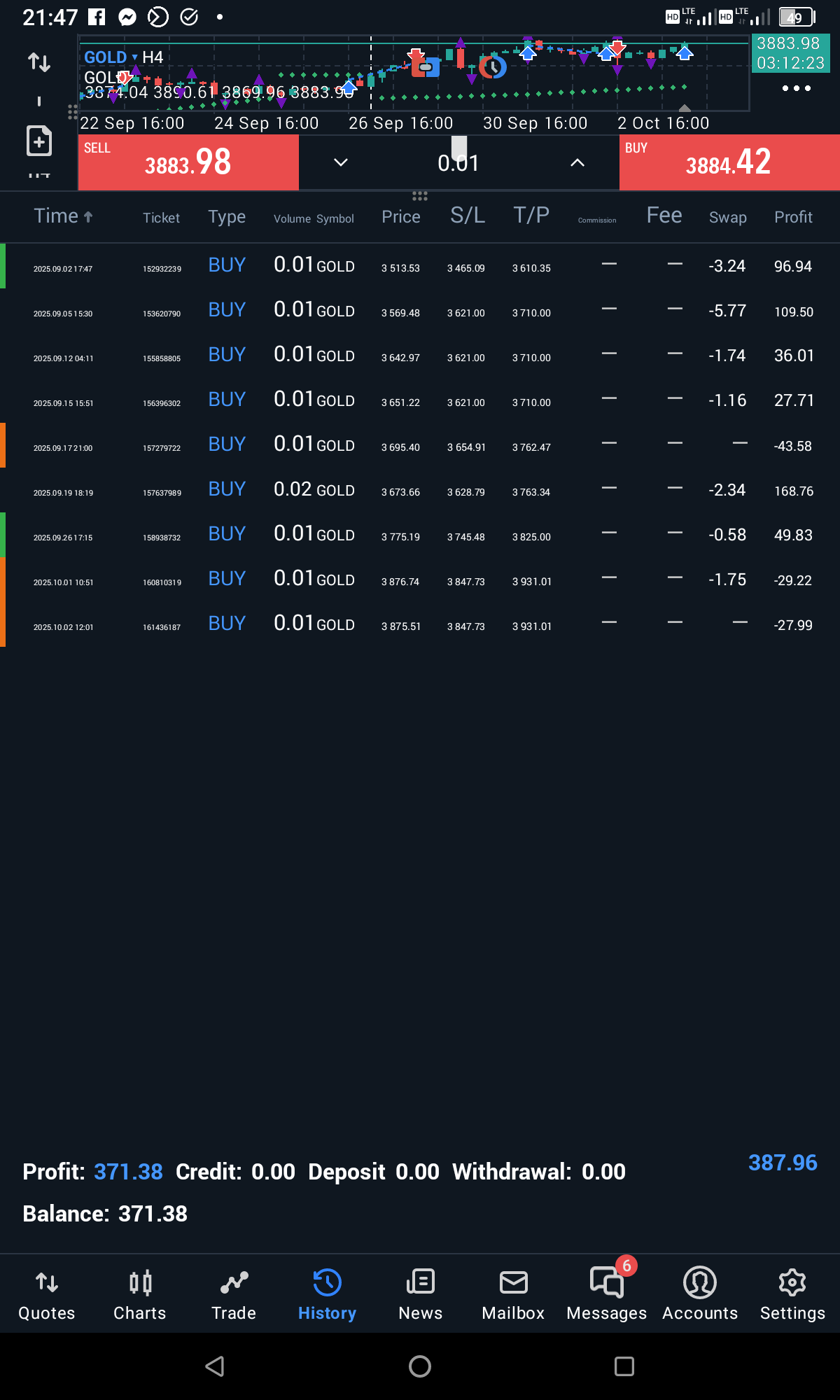
Pleased to share the performance results for September. By focusing exclusively on Gold (XAU/USD), the account achieved the following:
Net Profit: +$371.38
Account Growth: ~119% (growing from ~$310 to $681.37)
Strategy: The approach involved capturing high-impact moves in the market. This sometimes means accepting several small, managed losses while positioning for a trade with a significant risk-to-reward potential, such as the +$109.50 trade captured on September 4th.
Discipline and a solid mathematical edge are non-negotiable. Looking forward to a productive October.
The strategy is focused on identifying key breakout levels and managing the trades automatically. How have you been trading XAUUSD lately?
You can find the EA I'm using here on the MQL5 Market. Let's discuss our strategies!


Fractal Breakout EA Ein leistungsstarker und vollständig anpassbarer Expert Advisor, der für den Handel von Ausbrüchen aus klassischen Fraktalmustern entwickelt wurde. Mit seinen vielseitigen Einstellungen kann dieser EA für unterschiedliche Risikobereitschaften konfiguriert werden, von konservativen festen Lots bis hin zu aggressiveren Handelsmodi. Übersicht Der Fractal Breakout EA ist ein automatisierter Handelsroboter, der darauf ausgelegt ist, Momentum-Ausbrüche basierend auf einem
In the world of elite trading, the operator is not a mere speculator; they are the CEO of a sophisticated financial enterprise. They don't just "buy and sell." They manage a product line, deploy a sales force, and scrutinize a detailed Profit & Loss (P&L) statement. This is the quantum leap from amateur to professional—a shift from chasing signals to building a resilient, scalable business.
This definitive blueprint reframes your trading operation into a tangible business model. Here, your products are the currency pairs you trade. Your sales force is the team of Expert Advisors (EAs) you deploy. And every decision is weighed against a clear balance sheet of revenues and operational costs. We will build a feasibility model that not only accounts for market volatility but also for the real-world expenses of running your enterprise, from the "salaries" of your EAs to your infrastructure overhead.
This is the operational manual for the serious trading CEO.
🧠 Step 1: Architecting Your Enterprise: Products, Sales, and Costs
A robust business begins with a clear understanding of what it sells, who sells it, and what it costs to operate.
🔹 Your Product Line: The Currency Pair Catalog
Your products are the financial instruments you choose to trade. A well-curated product line is diverse yet specialized, designed to perform across different market "seasons."
Product Selection & Due Diligence: Evaluate each currency pair as a potential product.
Profit Margin (Volatility & Spread): Does the pair's Average True Range (ATR) provide enough movement to generate profit after accounting for its typical spread? Low volatility combined with high spreads makes for a low-margin product.
Market Hours (Liquidity): When is the product's primary "sales window"? Trading during its most liquid sessions (e.g., EURUSD during the London/New York overlap) reduces costs (tighter spreads) and improves execution.
Holding Costs (Swaps): If your business model involves holding trades overnight, are the swap rates positive or negative? Significant negative swaps are a hidden operational drag on your product's profitability.
Product Correlation: Diversify your product line. Holding five highly correlated JPY pairs is not diversification; it's a single concentrated bet on the Yen. Balance your catalog with uncorrelated assets (e.g., a major pair, a commodity like Gold, and a minor pair).
🔹 Your Automated Sales Force: The Expert Advisor Team
Your EAs are not magic black boxes; they are your tireless, 24/7 sales agents, executing your business strategy with perfect discipline. You must manage them as you would a high-performance team.
Hiring Your Agents (EA Selection):
Interview (Strategy Review): What is the EA's core logic? Does it align with your business model (trend-following, mean-reversion, breakout)? Understand its strategy completely.
Background Check (Backtesting): Conduct rigorous, long-term backtests using high-quality data (99.9% tick data) to verify its historical performance.
Probationary Period (Demo/Micro Testing): Never deploy a new agent directly onto a main account. A mandatory demo phase is required to confirm it performs as expected in a live environment.
Compensation (The "Salary"): Your EAs require payment. This is a fixed operational cost.
EA "Salary": A typical high-quality EA rental or subscription costs around $30 per month. This is a non-negotiable line item on your P&L.
🔹 The Cost of Doing Business: Your Operational P&L
A professional CEO tracks every single expense. Your trading P&L is more than just gross profit; it's your net profit after all costs are deducted.
Fixed Monthly Overhead: These are the predictable costs required to keep your business running.
EA Compensation: ~$30 / month
Infrastructure (The "Office Rent"): Using the MQL5 Cloud Network or a dedicated Virtual Private Server (VPS) is essential for low-latency execution and saves on home electricity bills. This is your "office space and utilities." Budget approximately $15 per month.
Total Fixed Overhead: ~$45 / month.
Variable Costs (Cost of Goods Sold - COGS): These costs are incurred on every transaction (trade).
Spreads & Commissions: The fee your broker (your "distributor") charges for each transaction.
Slippage: The difference between the expected price of a trade and the price at which the trade is actually executed. This is a very real, often underestimated, cost.
Swaps: Overnight financing charges for holding positions.
Your Net Profit is the only number that matters: Net Profit = Gross Profit - (Fixed Overhead + Variable Costs)
🚀 Step 2: Phased Deployment: Your Go-to-Market Strategy
This structured deployment process remains the gold standard for mitigating risk, moving from a controlled lab environment to full-scale market operation. Phase 1: R&D (Demo Sandbox) -> Phase 2: Incubation (Micro/Cent Account) -> Phase 3: Live Deployment
📅 Step 3: The 12-Month Strategic Roadmap
Your annual plan now includes financial oversight, tracking revenue against expenses with the rigor of a corporate controller.
Q1| Foundation & Flawless Execution| Deploy strategy on a small live account| Plan Adherence Rate, Gross P&L, Net P&L (after costs), Drawdown.
Q2| Data Analysis & Optimization| Analyze Q1 data. Make small, data-driven adjustments to the "product line" or "sales agent" settings.| ROI per Product (Pair), Profit Factor, Expectancy, Cost per Trade.
Q3| Controlled & Systematic Scaling| If profitable, begin scaling risk according to a pre-defined model.| Equity Curve Growth, Monthly Net Profit vs. Target, Recovery Factor.
Q4| Annual Review & Strategic Pivot| Full annual P&L review. Compare results against feasibility model. Formulate the next year's business plan.| Annual Net Profit, ROI vs. Feasibility, Sharpe Ratio, Consistency.
📐 Step 4: Financial Forecasting: The P&L-Driven Feasibility Model
This is where we integrate your operational costs directly into the 50/200 stress test to determine the real performance required to be profitable.
🔸 Calculating Your Break-Even and Profit Targets
Let's build a forecast for a trader with a $10,000 account.
Define Monthly Fixed Costs:
EA "Salary": $30
VPS/Cloud Infrastructure: $15
Total Fixed Costs: $45
Estimate Monthly Variable Costs:
This is tricky, but we must account for it. A conservative estimate is to budget 10-20% of your projected gross profit for these costs. For our model, let's add a buffer of $55/month to cover spreads, slippage, and swaps, bringing our total estimated monthly operational expense to around $100.
Set Your Monthly Net Profit Goal:
Let's say your goal is to achieve a $400 net profit per month.
Calculate Required Gross Profit:
This is the profit your EAs must generate before any expenses are deducted.
Required Gross Profit = Net Profit Goal + Total Monthly Expenses
$400 + $100 = **$500 Required Gross Profit**
Apply the 50% ROI Feasibility Filter:
The 50/200 rule states we should only count on 50% of our backtested returns. Therefore, to achieve a real-world gross profit of $500, our backtest must show double that amount.
Target Backtest Profit = Required Gross Profit / 0.50
$500 / 0.50 = **$1,000 Target Backtest Profit (per month)**
Conclusion of the Feasibility Model: For a trader with a $10,000 account to realistically target a $400 net monthly profit, their backtests must demonstrate that their strategy can generate $1,000 per month (a 10% monthly ROI). The business plan must also account for a potential 40% drawdown (if the backtest showed 20%), meaning the capital must be able to withstand a drop to $6,000.
This calculation transforms wishful thinking into a concrete, actionable business target.
📋 Step 5: Be Your Own CFO: Meticulous Financial Tracking
Your role as CEO requires you to monitor the financial health of your enterprise daily.
Comprehensive Trade Ledger: Log every trade with its rationale and outcome.
Expense Sheet: Maintain a simple spreadsheet logging all fixed and variable costs.
Monthly P&L Statement: At the end of each month, produce a formal statement: Gross Revenue (Profits) - Expenses = Net Profit/Loss.
🔄 Step 6 & 7: Strategic Adjustments & The Review Process
These steps remain crucial. Use your detailed P&L data to make informed decisions.
Isolating Directional Performance (Buy vs. Sell): Think of this as A/B testing two different sales approaches. If your "Buy" logic is generating 80% of the profit for a specific product (pair), consider reallocating capital or even disabling the underperforming "Sell" logic for that product.
The Quarterly Business Review (QBR): Your QBR is now a financial meeting. Was net profit positive? Were costs within budget? Which "products" are most profitable? Which "sales agents" deserve more capital allocation?
🧰 The Professional Trader's Toolkit
Your toolkit should now include financial management tools:
✅ Performance Dashboard (Myfxbook): To track revenue.
✅ Expense Tracking Software/Spreadsheet: To track costs.
✅ Professional Trading Journal (Edgewonk, TraderVue): To analyze the performance of every transaction.
🏁 Final Thoughts: From Trader to Enterprise CEO
By treating your trading as a business with products, employees, and a real P&L, you fundamentally change your relationship with the market. You are no longer gambling; you are manufacturing returns. You are no longer hoping; you are executing a strategic plan.
This detailed, cost-aware approach provides the ultimate psychological armor. A losing trade is no longer a personal failure; it's a cost of doing business, a data point to be analyzed. A drawdown is a budgeted-for risk, not a catastrophe. Success is measured not by one spectacular trade, but by consistent, positive net profitability month after month.
This is how you build an enterprise that lasts.
✅ Profit: $170.61 | Deposit: $365.96 | Balance: $589.88
Clean breakout entries with dynamic SL/TP and smart exposure control.
Used Buy-only setup with TP multiplier 2.0, martingale enabled, fixed lot 0.01.
Directional toggles let you fine-tune Buy/Sell logic per symbol.
📌 Available now on MQL5 Marketplace – Fractal Breakout EA

Fractal Breakout EA Ein leistungsstarker und vollständig anpassbarer Expert Advisor, der für den Handel von Ausbrüchen aus klassischen Fraktalmustern entwickelt wurde. Mit seinen vielseitigen Einstellungen kann dieser EA für unterschiedliche Risikobereitschaften konfiguriert werden, von konservativen festen Lots bis hin zu aggressiveren Handelsmodi. Übersicht Der Fractal Breakout EA ist ein automatisierter Handelsroboter, der darauf ausgelegt ist, Momentum-Ausbrüche basierend auf einem