Julien Jeremy Rodrigue Gazagnaire / 个人资料
- 信息
|
不
经验
|
3
产品
|
0
演示版
|
|
0
工作
|
0
信号
|
0
订阅者
|
通过他们的个人资料或用户搜索添加好友,您将能够看到他们是否在线
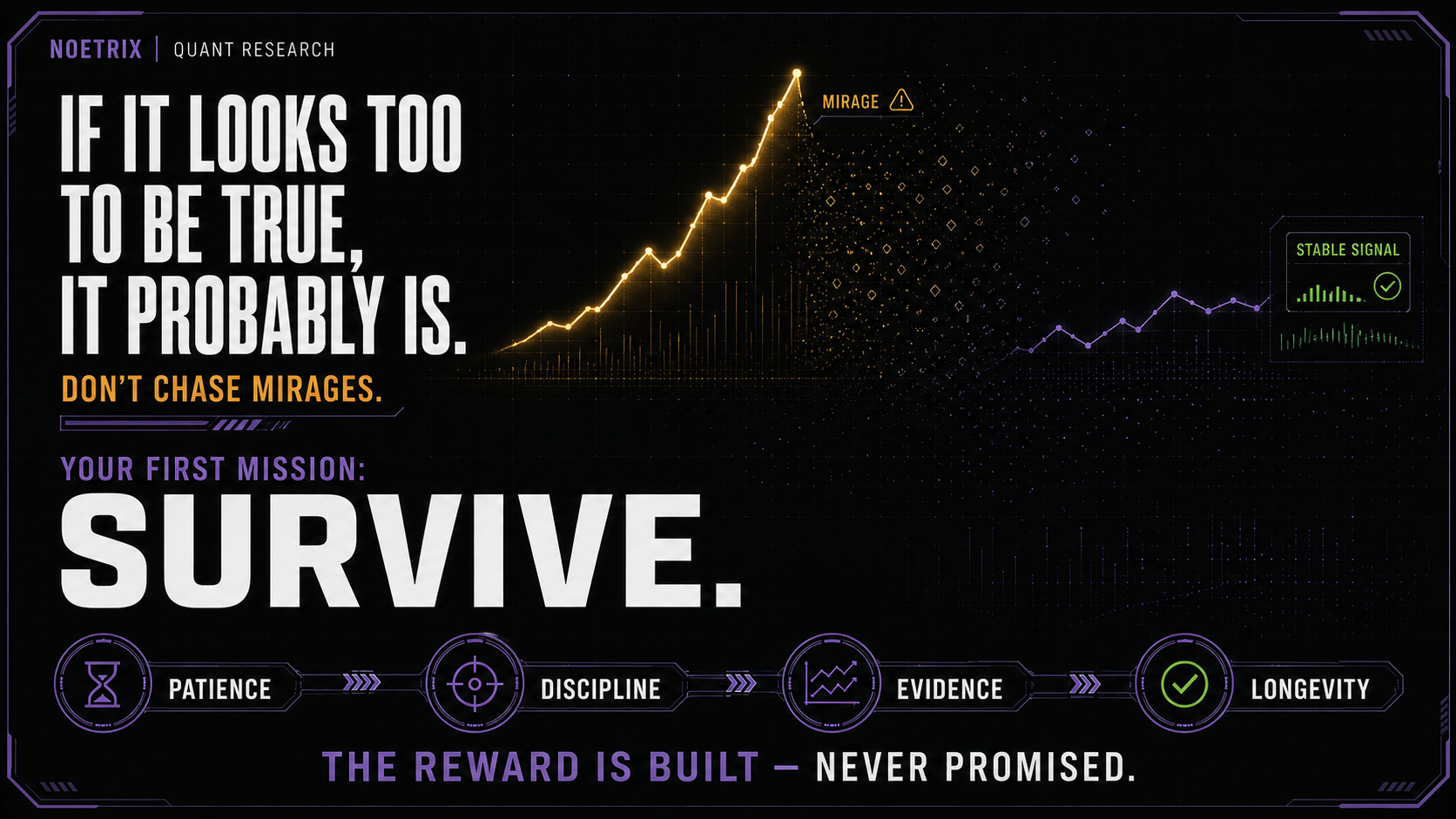
A compelling result is not yet evidence. In quantitative research, this distinction sounds obvious in theory, but it quickly becomes uncomfortable in practice. A smooth equity curve, a favorable ratio, or a profitable sequence of trades invites a conclusion. Yet none of these elements tells us whether the method survives a different period, whether the test can be reproduced, whether real execution matches the model, or whether the control mechanisms behave as claimed.
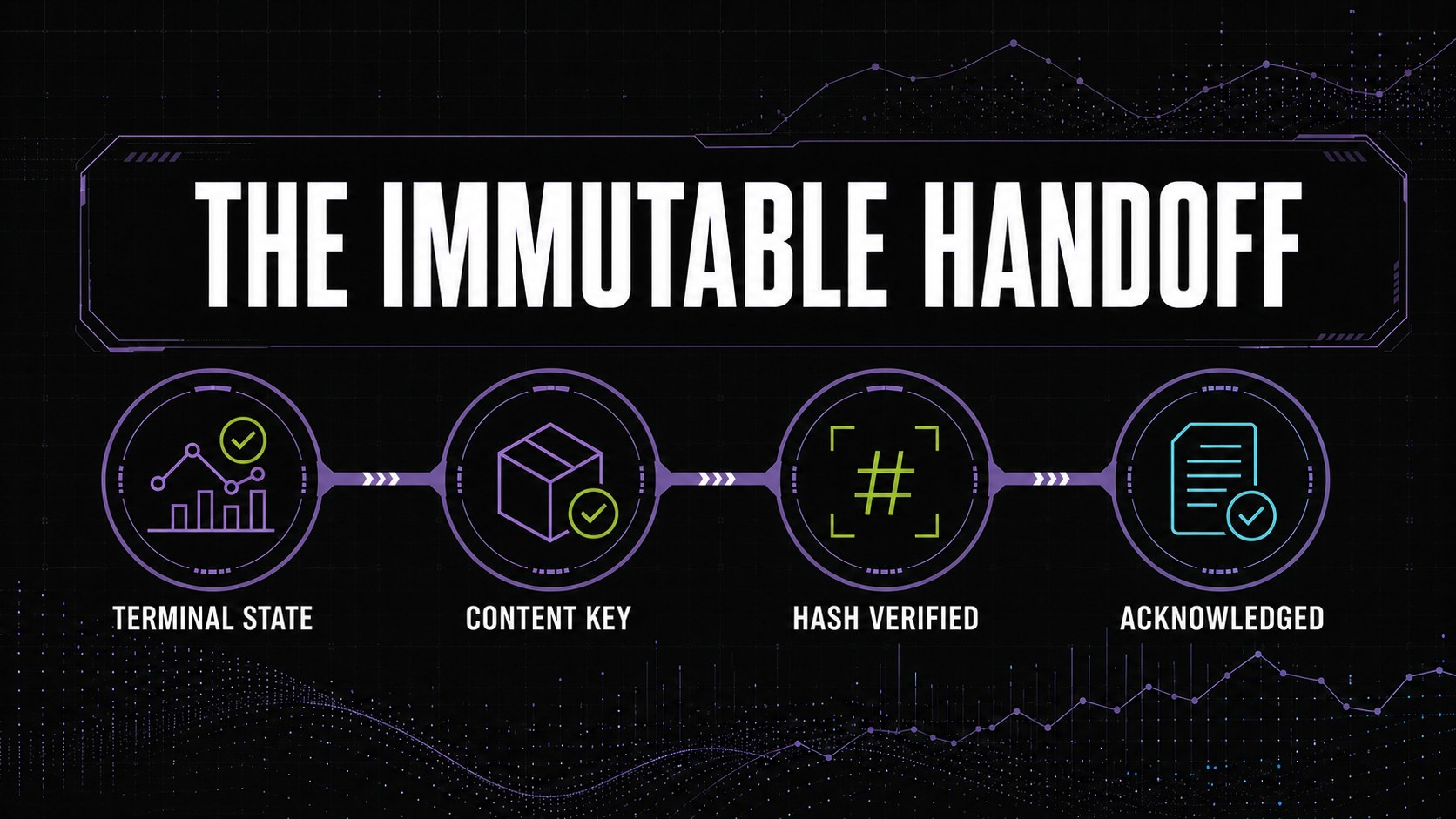
Credibility does not come from an isolated number. It comes from a chain of evidence: the origin of the result, the selection rule, data separation, independent validation, software controls, artifact traceability, and clearly acknowledged limitations. This is less spectacular than a performance promise, but far more useful.
## Selection Is Not Validation
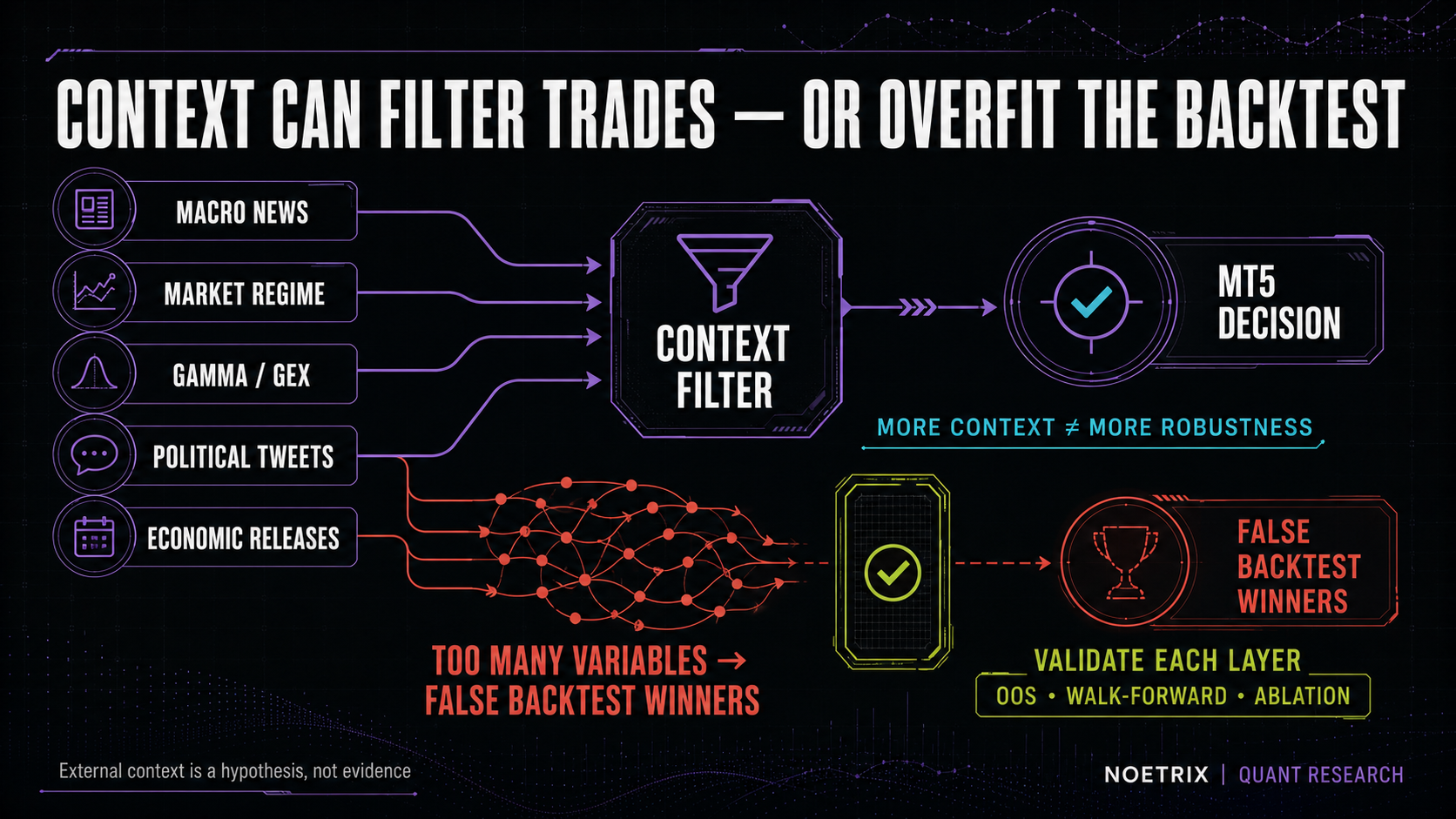
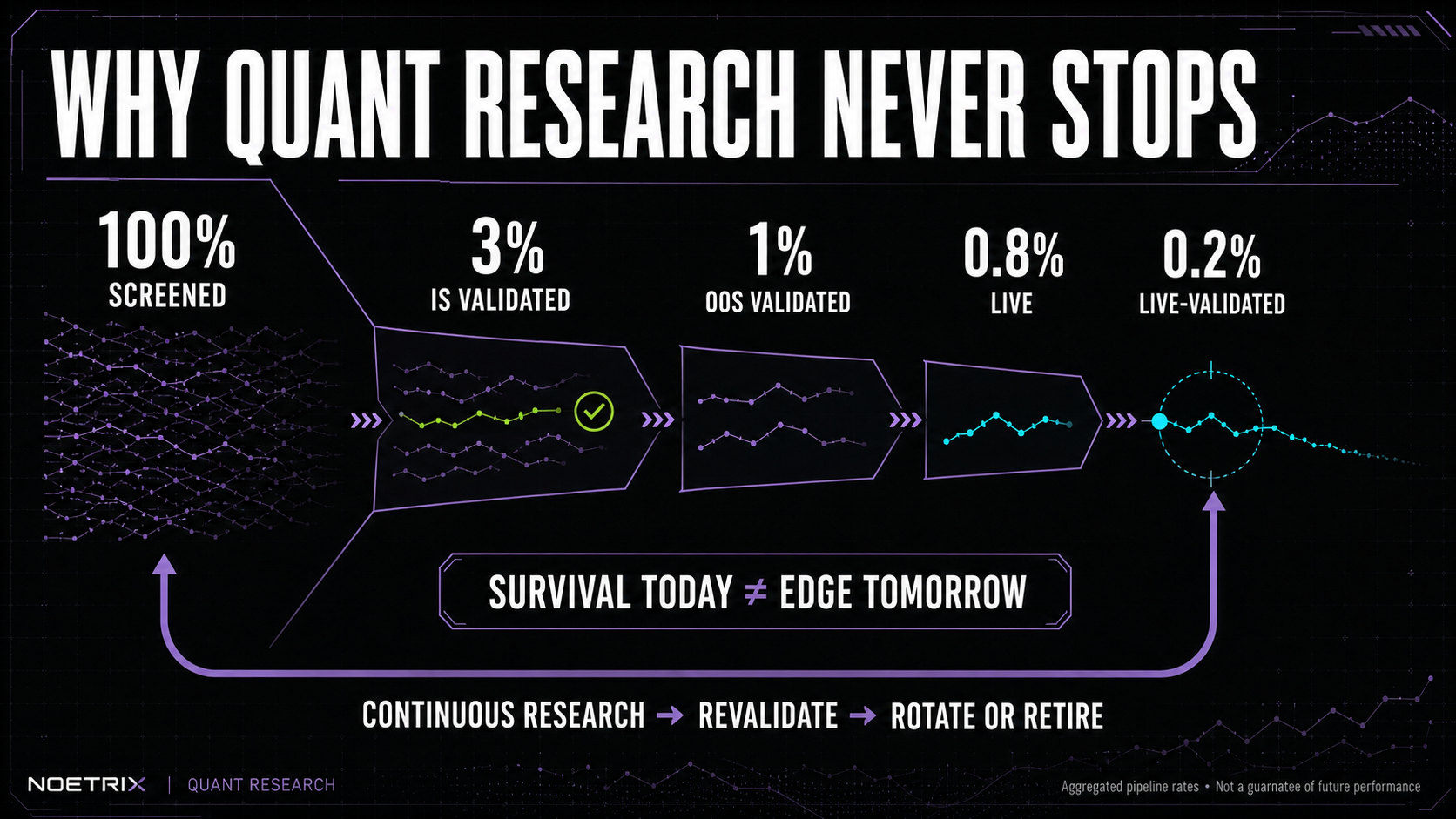
When many variants are tested, some will almost inevitably look excellent. That does not mean they contain a durable edge. Their apparent quality may reflect chance, excessive adaptation to the research period, or a parameter combination favored by the peculiarities of the sample.
A rigorous process must make its selection rule explicit. In recent Vanguard work, thirty variants were selected from two separate research campaigns. The documented rule was to retain the best profitable variant from each family, require at least thirty trades, and rank candidates using a profit-to-drawdown relationship. This rule does not prove that the selected variants will continue to work. It does, however, make it possible to understand exactly why they were chosen.
That nuance matters. Selection answers: “Which candidates deserve an additional test?” Validation answers a different question: “What remains of their behavior when the test conditions change?” Confusing the two means presenting discovery as confirmation.
## Out-of-Sample Must Remain Truly Out-of-Sample
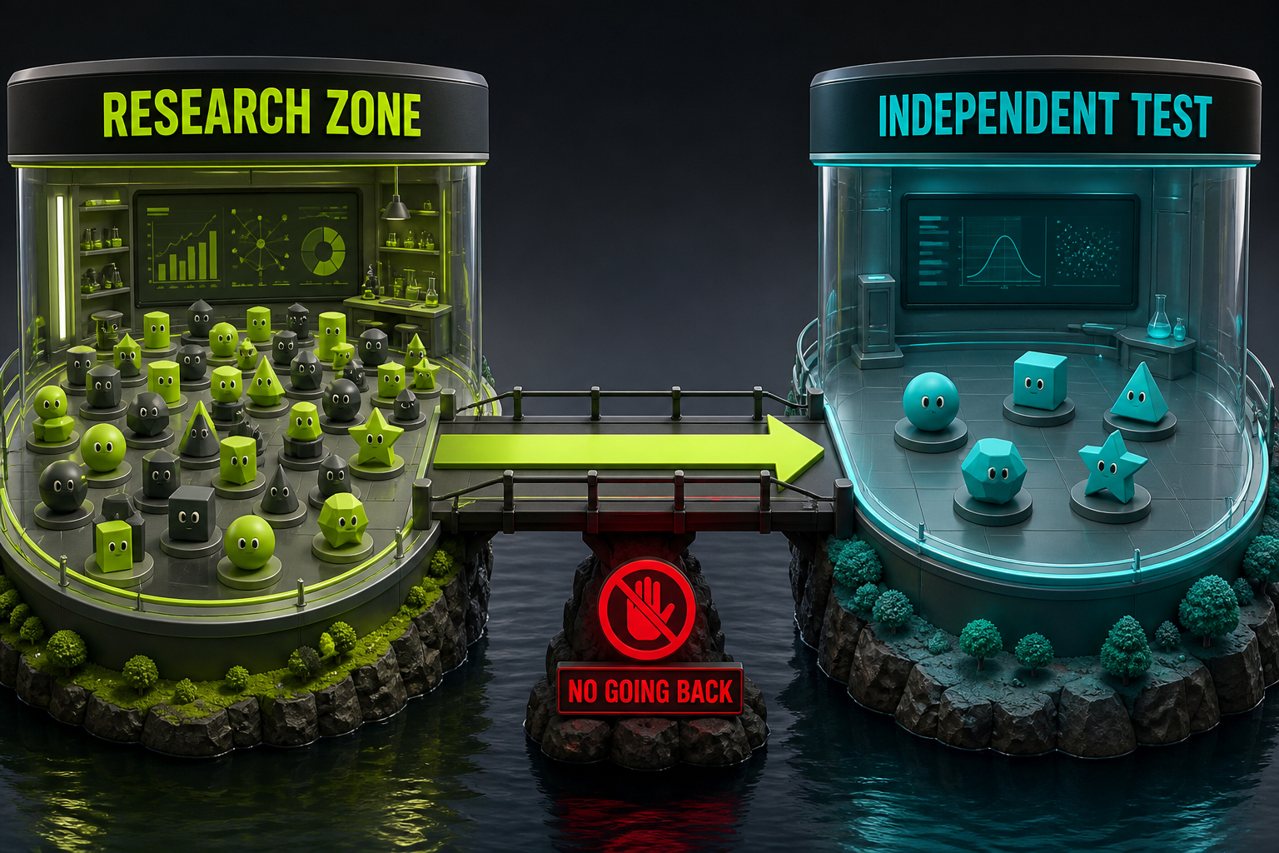
An out-of-sample test has value only when its period has not been used, directly or indirectly, to adjust the strategy. Moving a date in a report is not enough. The research space and the verification space must remain operationally separate.
In the current selection, the research period covers 2024 and 2025. Two independent windows are then used: 2023 and the available portion of 2026 through August 10. This structure observes a candidate both before and after the period used for selection. It guarantees nothing about the future, but it exposes several forms of fragility: dependence on a particular regime, a collapse in trade count, increased drawdown, or the disappearance of the apparent edge.
The objective is not to demand an out-of-sample result identical to the original one. Some degradation is normal. The useful question is whether that degradation remains compatible with the initial hypothesis. A system that survives only when the same conditions reappear is not robust; it is context-dependent.
## Evidence Must Be Traceable
A research chain becomes credible when a third party can travel backward from the final result to its components. Which campaign identifier produced the candidate? Which rule selected it? Which time interval was used? Which file records the decision? Which software version executed the test?
This traceability may appear administrative, but it prevents expensive errors. It avoids mixing campaigns, submitting the wrong artifact, overwriting an earlier result, or interpreting a provisional file as a final conclusion. It also makes it possible to resume an interrupted campaign while preserving the distinction between completed, ongoing, and pending work.
Campaign IDs, run IDs, and recorded periods do not improve a strategy. They make its claims verifiable. That difference is decisive: untraceable performance depends on trust, while traceable evidence can be audited.
## From the Laboratory to a Real Terminal
Statistical robustness is only one part of the problem. A MetaTrader tool must also demonstrate that it loads correctly, respects its functional boundaries, and does not turn unavailable information into a reassuring signal.
The recent validation of the Noetrix suite illustrates this second layer. All three products compiled without errors or warnings and were then checked on a real MT5 demo terminal. Lens and Sentinel were confirmed as tools with no trading capability. Guard retains protective functions, but its manual and reactive actions are disabled by default and protected by independent gates.
Real-terminal work also revealed corrections that do not appear in a backtest: handling an account with no positions, reporting missing history as unavailable rather than safe, controlling alert write frequency, reconstructing trades, and treating a disconnected terminal as critical. These details separate a visual demonstration from defensible software behavior.
## Declared Limitations Strengthen Credibility
Serious communication does not stop at what passed. It also states what remains to be demonstrated. For Noetrix, several tests remain intentionally open: protective actions on disposable demo positions, a reactive breach scenario, forced disconnection, very large account histories, multiple broker environments, and final MQL5 Market validation.
Publishing these limitations does not weaken the project. It prevents conclusions from exceeding the available evidence. A successful compilation does not prove multi-broker robustness. A demo-account test does not prove universal protection. Out-of-sample selection does not guarantee future performance. Every claim must remain proportional to the test that supports it.
## Building a Culture of Evidence
The best research infrastructure is not the one that produces the most results. It is the one that makes errors visible, preserves failures, separates stages, and prevents silent shortcuts. It should encourage five habits: document the rule before viewing the result, isolate validation data, preserve original artifacts, verify real software behavior, and publish limitations with the same precision as successes.
This discipline changes how a system is judged. Instead of asking only, “How much did it make in the test?”, we ask, “Which hypothesis was tested, under which conditions, with which safeguards, and what can we honestly conclude?”
Moving from performance to evidence is not a marketing step. It is the core of the engineering process. A strong metric attracts attention; a complete validation chain earns trust.
Noetrix Sentinel 1.10 Noetrix Sentinel is a native, read-only MetaTrader 5 operational supervision utility. It monitors terminal connectivity, latency, trading permissions, chart and EA presence, watched market feeds, optional Magic mappings, alerts and diagnostic evidence from a single chart. ## Safety and distribution - MetaEditor result: `0 errors, 0 warnings`. - Entry point: `MQL5/Experts/NoetrixSentinel/NoetrixSentinel.mq5`. - No trading library, order submission, position close, order
Noetrix Lens Read-only portfolio and performance analytics for MetaTrader 5. Noetrix Lens turns native MT5 account history into clear portfolio intelligence from a single chart. It is designed for traders who want to understand where results come from without giving an analytics tool control over their trading. Lens never places, modifies or closes trades. Algo Trading is not required. ## Main features - Portfolio overview with net P/L, return, trade count, Profit Factor, win rate, average net
I am building Noetrix Systems as a long-term MetaTrader 5 engineering project focused on risk transparency, execution discipline and reliable automation.
The objective is not to create one isolated Expert Advisor. Noetrix is being developed as an evolving ecosystem of risk-management tools, portfolio analytics, terminal supervision and algorithmic trading systems.
The first public release is Noetrix Guard, a free account-risk and prop-firm management dashboard for MetaTrader 5.
From a single chart, Guard can monitor:
- Daily closed, floating and combined P/L
- Daily loss limits
- Max Loss with EOD Trailing
- Overall account drawdown
- Position and margin exposure
- Estimated monetary risk at stop
- Starting equity and target progress
- Locked protective actions such as Close, Reduce, Breakeven and Flatten
Guard does not provide trading signals and never opens speculative positions by itself. Its purpose is to make risk visible, rules understandable and protective actions deliberate.
It is built in native MQL5, without DLLs, external cloud services, telemetry or personal-data collection.
Noetrix Guard is available for free because I want it to become a practical tool shaped by real traders, not only by assumptions made during development.
The system is under continuous development, and constructive feedback is welcome. If you test it, please share:
- The prop-firm rules you would like to configure
- Metrics or controls that are missing
- Workflow or interface improvements
- Broker-specific situations or edge cases
- Features that would make the product more useful in daily trading
Every serious suggestion will be reviewed and may help shape future versions of Guard and the wider Noetrix ecosystem.
If you value transparent risk management, native MT5 engineering and products built around real user feedback, follow the development of Noetrix Systems and try Noetrix Guard on a demo account.
Systems. Risk. Precision. Continuous improvement.
Noetrix Guard ## 在一个 MT5 面板中管理账户风险与保护操作 Noetrix Guard 将账户风险监控、可配置交易限制和保护操作集中在一个原生 MetaTrader 5 界面中。它适用于手动交易者、自动化策略组合以及需要清晰查看风险状态而不改变原有交易策略的考核账户。 只需将 Guard 加载到一个图表,即可监控整个账户。面板显示余额、净值、可用保证金、当日交易结果、当前敞口、止损风险估算,以及距离已配置限制的剩余空间。 ## Guard 监控的内容 - 当日已平仓盈亏、浮动盈亏和当日综合盈亏。 - 固定金额或百分比形式的每日亏损限制。 - 按经纪商服务器时间或所选 UTC 时差配置每日重置时间。 - Max Loss (EOD Trailing):根据设定日终边界保存的最高净值记录计算。 - 从固定初始基准或余额/净值高水位计算总体回撤。 - 持仓、挂单、交易量、Magic Number 和止损状态。 - 使用经纪商原生交易品种参数估算止损位置的货币风险。 - 按品种显示多头、空头、净敞口和总敞口,并估算保证金。 - 初始净值、利润目标和目标进度。 -