Ngoc Sang Nguyfn
Ngoc Sang Nguyfn
  • Information
1 year
experience
0
products
0
demo versions
0
jobs
1
signals
0
subscribers
Friends

Add friends via their profile or user search and you will be able to see if they are online

Ngoc Sang Nguyfn Published MetaTrader 5 signal
Resu Signal Safe
Price: 30 USD, Growth: -99.47%
RESU – Adaptive Recovery Trading Strategy RESU is an automated trading strategy combining market-based entries with adaptive position recovery. It uses small initial positions, dynamically adjusts recovery lot sizes, and manages basket exits to capture profits from price retracements. The strategy focuses on systematic execution and consistent profit opportunities. As a recovery-based system, it may experience significant floating drawdowns during strong market trends
Ngoc Sang Nguyfn
Ngoc Sang Nguyfn
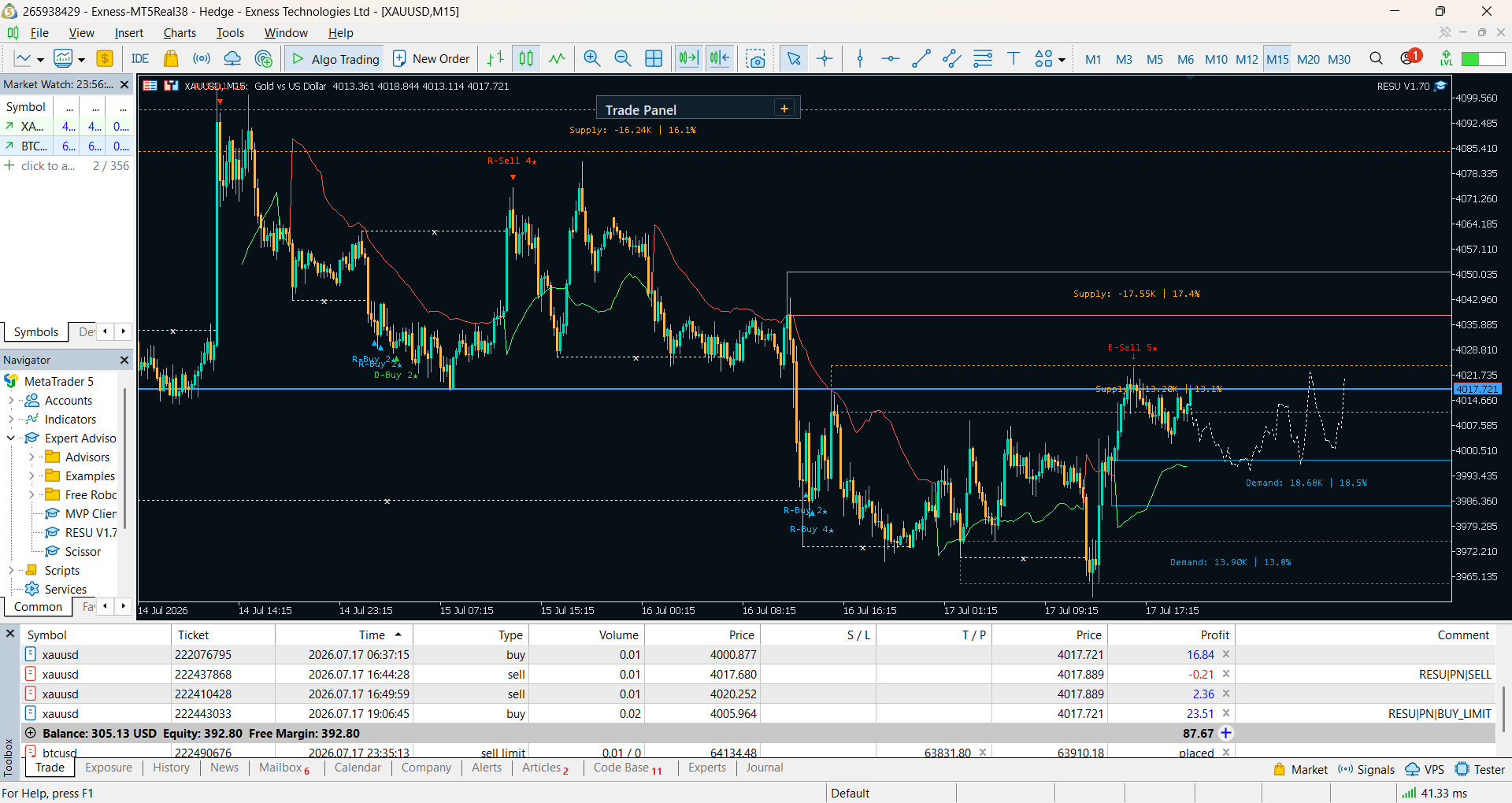
RESU for MT5 — A Modular Supply/Demand and Multi-Signal Trading Assistant

Hello MQL5 community,

I would like to introduce a project I have been developing for MetaTrader 5 called RESU.

RESU is not designed as a “one-indicator strategy” or a black-box system that promises guaranteed profits. It is a modular trading assistant built to organize several types of market information into one structured workflow:

Supply and Demand zones
Momentum reversal signals
Anchor-based price and momentum confirmation
Exhaustion signals
Confirmed market structure
Predict and Extension zones
Confidence scoring
Multi-timeframe virtual signal tracking
Optional automatic execution
Manual trade management
News and notification modules

The main objective is to help traders evaluate context before making a decision, rather than relying on a single isolated signal.

Why I Started Building RESU

Many trading tools are useful individually, but they often operate without enough context.

For example:

A momentum reversal can occur directly into a strong resistance zone.
A Supply or Demand zone may be valid, but the entry timing may still be poor.
A market-structure break may be confirmed, but volatility may already be excessive.
An exhaustion signal may appear before the market has completed its final expansion.
A good signal may become dangerous during high-impact economic news.

RESU was designed to combine these different layers without forcing them into one oversized entry condition.

Each module has its own responsibility. Signals can still be displayed independently, while execution filters decide whether an actual order should be allowed.

1. Supply and Demand Engine

The Supply and Demand module searches for specific candle sequences combined with abnormal volume behavior.

Zone size is adjusted using ATR rather than a fixed number of points. This allows the zones to adapt more naturally to symbols and market conditions with different volatility.

The engine also manages:

Fresh and retested zones
Zone invalidation
Overlapping-zone cleanup
Creation cooldowns
Maximum zones per side
Multi-timeframe zone scanning
Alerts when price enters an active zone

The goal is not to display every possible historical level. RESU tries to keep the chart focused on zones that remain relevant.

2. Three Independent Signal Families

RESU currently uses three main signal families: R, D, and E.

R — Reversal from Momentum Extremes

The R engine calculates a weighted pressure score using candle structure and volume behavior.

It remembers when momentum enters a strong bullish or bearish state. A reversal signal is generated when the score exits that extreme state in the opposite direction.

Conceptually:

Strong bullish pressure
→ Momentum weakens
→ R-Sell confirmation

or:

Strong bearish pressure
→ Momentum recovers
→ R-Buy confirmation

This is different from simply checking whether an oscillator is overbought or oversold.

D — Anchor-Based Confirmation

The D engine starts by storing an anchor when momentum reaches an extreme condition.

During a limited number of following candles, it monitors both:

The change in momentum score
The creation of a new price extreme

A D signal is confirmed only when both requirements are satisfied.

This creates a divergence-style confirmation model without depending entirely on traditional pivot divergence.

E — Sequential Exhaustion

The E engine counts sequential bullish or bearish exhaustion conditions.

A signal is generated when the configured exhaustion level is reached, and the sequence is reset at a later threshold.

The E signal is designed to identify situations where a directional move may be approaching a temporary exhaustion point.

These three engines are intentionally independent. One signal does not need to wait for another signal family before appearing.

3. Confirmed Market Structure

RESU includes a confirmed pivot and market-structure module.

It detects:

Confirmed pivot highs and lows
Bullish and bearish structure breaks
Pending breaks that have not yet been confirmed by a candle close
BOS-style structure lines
Predict zones
Extension zones

A structure break is accepted only after a closed candle confirms the break.

When a valid break occurs, RESU builds two contextual areas:

Predict Zone

A retracement area derived from the confirmed structure leg. It represents a possible pullback region following a structural expansion.

Extension Zone

A projected area beyond the completed structure leg. It represents a possible expansion or exhaustion region.

Only the latest relevant Predict and Extension zones are maintained, helping reduce chart clutter.

4. Confidence Score from 0★ to 5★

Every R, D, or E signal can be assigned a Confidence Score.

The score evaluates several contextual conditions, including:

Fast and slow EMA context
Supply or Demand alignment on the selected higher timeframe
Supply or Demand alignment on the signal timeframe
Predict or Extension zone alignment

The result is displayed directly with the signal:

R-Buy 3★
D-Sell 4★
E-Buy 2★

The score is visible on:

Chart labels
Telegram notifications
MT5 mobile push notifications
The virtual signal tracker

A separate automatic-entry filter allows the user to define a minimum accepted score.

For example:

Minimum score = 3★

0★, 1★, 2★ → displayed but not traded automatically
3★, 4★, 5★ → eligible for automatic execution

This separation is important. A low-score signal is not hidden from the trader. It is only prevented from opening a real position when the filter is enabled.

5. Multi-Timeframe Virtual Signal Tracker

Before enabling real automatic trading, I wanted a way to observe how signals behave across multiple timeframes.

The Live Signals module tracks virtual R, D, and E signals on four selectable timeframes.

For each virtual signal, it records:

Signal type
Direction
Confidence Score
Virtual entry price
Initial stop loss
Take profit
Break-even state
Current status
Result in R-multiple

Possible states include:

Active
Break Even
Closed by TP
Closed by SL

This module does not send real orders. Its purpose is to collect structured observations and compare signal quality before changing real execution settings.

6. Optional Automatic Trading

Automatic trading is disabled by default.

When enabled, a real entry must pass several checks:

Signal type is allowed
Confidence Score meets the selected minimum
News filter does not block entry
Zone requirement is satisfied when enabled
Maximum same-direction position count is not exceeded
The signal has not already been traded
The EA is not rebuilding historical state

The automatic-entry module supports:

Configurable lot size
Initial stop loss
Initial take profit
Maximum positions per direction
Magic-number isolation
Slippage control
Optional trailing stop
Optional management of manual positions

RESU can therefore be used in three different ways:

Indicator and decision-support mode
Semi-automatic trading assistant
Filtered automatic execution
7. Trade Panel

The integrated Trade Panel provides manual controls without opening the standard MT5 order dialog repeatedly.

Current functions include:

Buy Market
Sell Market
Buy Limit
Sell Limit
Delete pending limits
Close Buy
Close Sell
Close All
Break Even for matching positions
Set Buy TP for all matching Buy positions
Set Buy SL for all matching Buy positions
Set Sell TP for all matching Sell positions
Set Sell SL for all matching Sell positions

Trade-management actions are restricted by the current symbol and the configured EA Magic Number.

This prevents the panel from unintentionally modifying unrelated positions.

8. Market Context and Notifications

Additional modules include:

Market Regime Panel

The panel summarizes:

Trend direction
Volatility condition
Directional strength

It uses EMA, ATR, ADX, and directional-movement information across selectable timeframes.

Economic News Filter

The news module supports:

Currency filtering
Impact filtering
Configurable time windows before and after news
News lines and labels on the chart
Optional blocking of automatic entries
Telegram and MT5 Push

RESU can send:

R, D, and E signal notifications
Confidence Scores
Signal timeframe and price
Supply or Demand zone-entry alerts
MT5 mobile notifications
Chart screenshots through a Telegram command

Duplicate guards are used to reduce repeated notifications for the same signal.

9. Historical Reconstruction and Closed-Bar Processing

One of the more difficult parts of the project was rebuilding state correctly when the EA is attached to a chart.

RESU processes historical candles from older to newer candles to reconstruct:

Supply and Demand zones
Momentum states
D anchors
Exhaustion sequences
Pivot structure
Predict and Extension zones
Historical Confidence Scores

Real trading is explicitly disabled during this reconstruction process.

Confirmed pivots and closed-candle processing are used wherever possible to reduce intrabar instability and avoid using future information when evaluating historical signals.
Ngoc Sang Nguyfn
Registered at MQL5.community