Abdur Rahman Rana / Profile
I am a funded Forex trader with Funding Pips, trading firm capital and consistently generating profits while receiving regular profit splits. My trading approach is built on discipline, risk management, and consistency rather than chasing high-risk opportunities. I focus on structured trading plans, maintaining emotional control, and executing proven strategies with precision. My goal is long-term, sustainable performance in the financial markets.
Abdur Rahman Rana
Every day is not a money-making day in trading.
Some days you will lose.
Some days you will win.
And some days, you simply sit out and take no trade.
The sooner you realize and accept this,
the better it will be for you.
Remember:
Your job is not to trade every day.
Your job is to execute only when your system gives you a valid setup.
If there is no setup, NO TRADE is also a good trade.
Some days you will lose.
Some days you will win.
And some days, you simply sit out and take no trade.
The sooner you realize and accept this,
the better it will be for you.
Remember:
Your job is not to trade every day.
Your job is to execute only when your system gives you a valid setup.
If there is no setup, NO TRADE is also a good trade.
Abdur Rahman Rana
Stop expecting every trade to be a winner.
Tell yourself, "I didn't lose—the loss belongs to my trading system on this trade."
One losing trade will never define your trading career or your future. In the long run, your discipline, risk management, and consistency are what determine your success.
Trust your system. Follow your rules. Execute every trade without emotion, and focus on the process rather than the outcome.
Stay consistent, and the profits will follow.
Tell yourself, "I didn't lose—the loss belongs to my trading system on this trade."
One losing trade will never define your trading career or your future. In the long run, your discipline, risk management, and consistency are what determine your success.
Trust your system. Follow your rules. Execute every trade without emotion, and focus on the process rather than the outcome.
Stay consistent, and the profits will follow.
Abdur Rahman Rana
There is no such thing as certainty in trading. The entire game is based on probability.
As a trader, the only things you truly control are risk management, position sizing, and your psychology. Where the market goes is never under your control.
Yet many so-called analysts make bold price predictions as if the market were their personal property. The reality is that the market belongs to no one.
A professional trader doesn't try to predict the future. They focus on managing risk, executing their edge with discipline, and letting probability play out over a series of trades.
Stop chasing certainty. Trust your process, manage your risk, and stay consistent. That's what creates long-term profitability.
As a trader, the only things you truly control are risk management, position sizing, and your psychology. Where the market goes is never under your control.
Yet many so-called analysts make bold price predictions as if the market were their personal property. The reality is that the market belongs to no one.
A professional trader doesn't try to predict the future. They focus on managing risk, executing their edge with discipline, and letting probability play out over a series of trades.
Stop chasing certainty. Trust your process, manage your risk, and stay consistent. That's what creates long-term profitability.
Abdur Rahman Rana
Never give up.
Trading is a business that can completely change your life. Once you become consistently profitable, you'll achieve results that may seem impossible today.
Personally, I never take a trade unless my strategy gives me a valid setup. I trust my strategy completely. I know that individual trades may end in a loss, but as long as I follow my rules with discipline and proper risk management, I'm confident I'll finish the month in profit—whether it's a small profit or a big one.
I truly believe that everyone in this group can become profitable. If you take every valid setup according to your trading plan, maintain proper money management, and stay disciplined, then Insha'Allah, you'll be profitable over the long run.
Trading is a business that can completely change your life. Once you become consistently profitable, you'll achieve results that may seem impossible today.
Personally, I never take a trade unless my strategy gives me a valid setup. I trust my strategy completely. I know that individual trades may end in a loss, but as long as I follow my rules with discipline and proper risk management, I'm confident I'll finish the month in profit—whether it's a small profit or a big one.
I truly believe that everyone in this group can become profitable. If you take every valid setup according to your trading plan, maintain proper money management, and stay disciplined, then Insha'Allah, you'll be profitable over the long run.
Abdur Rahman Rana
The belief that a bigger trading account automatically means bigger profits is completely wrong.
You can have billions of dollars and still be a losing trader if you lack discipline, risk management, and a proven trading system.
On the other hand, someone with just $1,000 can generate consistent profits by following a structured plan and managing risk properly.
In Forex, success is not determined by the size of your account—it is determined by your discipline, consistency, risk management, and execution.
Capital doesn't make a profitable trader. Skill and discipline do.
You can have billions of dollars and still be a losing trader if you lack discipline, risk management, and a proven trading system.
On the other hand, someone with just $1,000 can generate consistent profits by following a structured plan and managing risk properly.
In Forex, success is not determined by the size of your account—it is determined by your discipline, consistency, risk management, and execution.
Capital doesn't make a profitable trader. Skill and discipline do.
Abdur Rahman Rana
Every valid setup deserves the same risk.
I don't pick and choose trades based on emotions or recent results. If my setup meets all the rules of my trading system, I execute it with my predefined risk—every single time.
I trust my edge, not my feelings. My job is not to predict the market; my job is to follow my system with discipline and consistency.
Profit and loss are beyond my control. The only thing I can control is my execution. That's where my focus stays.
One trade means nothing. Hundreds of disciplined trades create long-term profitability.
No fear. No greed. No hesitation. Just disciplined execution.
I don't pick and choose trades based on emotions or recent results. If my setup meets all the rules of my trading system, I execute it with my predefined risk—every single time.
I trust my edge, not my feelings. My job is not to predict the market; my job is to follow my system with discipline and consistency.
Profit and loss are beyond my control. The only thing I can control is my execution. That's where my focus stays.
One trade means nothing. Hundreds of disciplined trades create long-term profitability.
No fear. No greed. No hesitation. Just disciplined execution.
Abdur Rahman Rana
Please read every word carefully.
If you truly understand and apply these principles to your own trading, I'm confident they can help you become a consistently profitable trader.
Trading success doesn't happen overnight.
It doesn't matter how many stop losses (SLs) you take in a single day. What matters is whether you followed your trading system with discipline.
I've taken 7 consecutive SLs and still finished the month in profit. Why? Because I trust my system and focus on the long-term outcome, not the result of a single trade.
Profitable traders don't judge themselves by one trade—they judge their performance over hundreds of disciplined trades.
Every chart you analyze, every rule you follow, and every mistake you learn from brings you one step closer to success.
So don't quit.
Stay disciplined. Stay consistent. Trust your process.
Remember: Losses are part of the game. Discipline is your edge. Consistency is the key to long-term profitability.
If you truly understand and apply these principles to your own trading, I'm confident they can help you become a consistently profitable trader.
Trading success doesn't happen overnight.
It doesn't matter how many stop losses (SLs) you take in a single day. What matters is whether you followed your trading system with discipline.
I've taken 7 consecutive SLs and still finished the month in profit. Why? Because I trust my system and focus on the long-term outcome, not the result of a single trade.
Profitable traders don't judge themselves by one trade—they judge their performance over hundreds of disciplined trades.
Every chart you analyze, every rule you follow, and every mistake you learn from brings you one step closer to success.
So don't quit.
Stay disciplined. Stay consistent. Trust your process.
Remember: Losses are part of the game. Discipline is your edge. Consistency is the key to long-term profitability.
Abdur Rahman Rana
Trading is not easy. It's a game of discipline, not luck.
If you think trading is easy, you still don't understand the market.
Master discipline and consistency before you focus on making money.
A truly profitable trader is someone who can take 7 stop losses in a row, never break their rules, never increase risk out of frustration, never revenge trade, and still finish the month profitable or at least break-even.
One winning trade won't make you successful. One profitable month won't make you a professional.
Success comes from executing the same proven process over hundreds of trades with unwavering discipline.
Stay patient.
Stay consistent.
Stay disciplined.
The market will always create new opportunities—but it never rewards undisciplined traders.
If you think trading is easy, you still don't understand the market.
Master discipline and consistency before you focus on making money.
A truly profitable trader is someone who can take 7 stop losses in a row, never break their rules, never increase risk out of frustration, never revenge trade, and still finish the month profitable or at least break-even.
One winning trade won't make you successful. One profitable month won't make you a professional.
Success comes from executing the same proven process over hundreds of trades with unwavering discipline.
Stay patient.
Stay consistent.
Stay disciplined.
The market will always create new opportunities—but it never rewards undisciplined traders.
Abdur Rahman Rana
A successful trader's greatest strength is not just their strategy—it's their discipline.
If a person is not disciplined in daily life—doesn't wake up on time, fails to follow a routine, neglects their physical and mental well-being, or isn't consistent with their prayers or personal commitments—it becomes very difficult to be consistent in trading.
Many traders work on a strategy for only a few days before abandoning it in search of a new one. Then they repeat the same cycle with another strategy. They believe the problem lies in the strategy, when in reality, the real issue is a lack of consistency and discipline.
Successful traders don't constantly change strategies. Instead, they focus on improving their habits, mindset, and execution. They understand that long-term success comes from consistently following a proven plan.
Remember, the true measure of success in trading is not how much money is in your account. What really matters is your ability to generate consistent percentage returns while following your trading plan with discipline.
Discipline creates consistency. Consistency creates profitability.
If a person is not disciplined in daily life—doesn't wake up on time, fails to follow a routine, neglects their physical and mental well-being, or isn't consistent with their prayers or personal commitments—it becomes very difficult to be consistent in trading.
Many traders work on a strategy for only a few days before abandoning it in search of a new one. Then they repeat the same cycle with another strategy. They believe the problem lies in the strategy, when in reality, the real issue is a lack of consistency and discipline.
Successful traders don't constantly change strategies. Instead, they focus on improving their habits, mindset, and execution. They understand that long-term success comes from consistently following a proven plan.
Remember, the true measure of success in trading is not how much money is in your account. What really matters is your ability to generate consistent percentage returns while following your trading plan with discipline.
Discipline creates consistency. Consistency creates profitability.
Abdur Rahman Rana
It takes time for time itself to change.
Be patient, and keep putting in the work.
InshaAllah, one day your time will change too.
Be patient, and keep putting in the work.
InshaAllah, one day your time will change too.
Abdur Rahman Rana
📈 My job in trading is not to predict the market. My job is to execute my setup.
I don't know whether a trade will hit TP or SL, and I don't need to know.
✅ Setup appears → I enter the trade
✅ Risk is defined → SL is placed
✅ Target is defined → TP is placed
After that, the market decides the outcome.
A consistent trader does not focus on winning every trade. Instead, they focus on following the same process, rules, and discipline every single time.
I cannot control the market, but I can control my execution.
Today's goal is not profit.
Today's goal is flawless execution.
Because long-term success comes from consistency, not prediction.
🔥 Trust the process.
🔥 Follow the rules.
🔥 Stay consistent.
I don't know whether a trade will hit TP or SL, and I don't need to know.
✅ Setup appears → I enter the trade
✅ Risk is defined → SL is placed
✅ Target is defined → TP is placed
After that, the market decides the outcome.
A consistent trader does not focus on winning every trade. Instead, they focus on following the same process, rules, and discipline every single time.
I cannot control the market, but I can control my execution.
Today's goal is not profit.
Today's goal is flawless execution.
Because long-term success comes from consistency, not prediction.
🔥 Trust the process.
🔥 Follow the rules.
🔥 Stay consistent.
Abdur Rahman Rana
Many traders hate Stop Loss. But what they don't realize is that Stop Loss is protecting them.
People often say,
"My Stop Loss got hit today. I took a losing trade."
No.
You didn't lose.
You stopped a loss from becoming a much bigger one.
A Stop Loss doesn't define a losing trader—it defines a disciplined trader. It's not a sign of failure; it's a risk management tool designed to protect your capital.
Think of it this way:
You're driving down the road, and the traffic light turns red. You stop.
Does that mean your journey is over?
Of course not.
You simply pause, wait for the road to clear, and continue when the light turns green.
A Stop Loss works exactly the same way.
It doesn't end your trading journey. It simply tells you, "This trade is over. Protect your capital and wait for the next opportunity."
Remember:
A Stop Loss doesn't stop your success—it protects your future.
People often say,
"My Stop Loss got hit today. I took a losing trade."
No.
You didn't lose.
You stopped a loss from becoming a much bigger one.
A Stop Loss doesn't define a losing trader—it defines a disciplined trader. It's not a sign of failure; it's a risk management tool designed to protect your capital.
Think of it this way:
You're driving down the road, and the traffic light turns red. You stop.
Does that mean your journey is over?
Of course not.
You simply pause, wait for the road to clear, and continue when the light turns green.
A Stop Loss works exactly the same way.
It doesn't end your trading journey. It simply tells you, "This trade is over. Protect your capital and wait for the next opportunity."
Remember:
A Stop Loss doesn't stop your success—it protects your future.
Abdur Rahman Rana
A trader is not born successful.
A true trader is forged through countless losses, hundreds of mistakes, sleepless nights, broken dreams, frustration, mental pressure, and the criticism of others.
Trading is far more than reading charts or placing Buy and Sell orders. It is a journey of patience, discipline, self-control, and continuous learning.
The trader you admire today has likely failed more times than you can imagine. The difference is that they never gave up. They learned from every mistake, improved themselves, and kept moving forward.
So don't judge a trader by their profits alone. Respect the struggle behind the success. Every consistently profitable trader has a story filled with setbacks, failures, and perseverance. Those difficult chapters are what eventually become the story of success.
Trading isn't about avoiding failure—it's about refusing to quit.
A true trader is forged through countless losses, hundreds of mistakes, sleepless nights, broken dreams, frustration, mental pressure, and the criticism of others.
Trading is far more than reading charts or placing Buy and Sell orders. It is a journey of patience, discipline, self-control, and continuous learning.
The trader you admire today has likely failed more times than you can imagine. The difference is that they never gave up. They learned from every mistake, improved themselves, and kept moving forward.
So don't judge a trader by their profits alone. Respect the struggle behind the success. Every consistently profitable trader has a story filled with setbacks, failures, and perseverance. Those difficult chapters are what eventually become the story of success.
Trading isn't about avoiding failure—it's about refusing to quit.
Abdur Rahman Rana
I sacrificed the need for instant results. I gave up overtrading, chasing losses, and letting emotions control my decisions. I spent countless hours studying, backtesting, and reviewing my trades instead of looking for shortcuts. I accepted that losses are part of the game and focused on following my trading plan with discipline and consistency. Becoming profitable wasn't about finding a perfect strategy—it was about becoming the right trader.
Abdur Rahman Rana
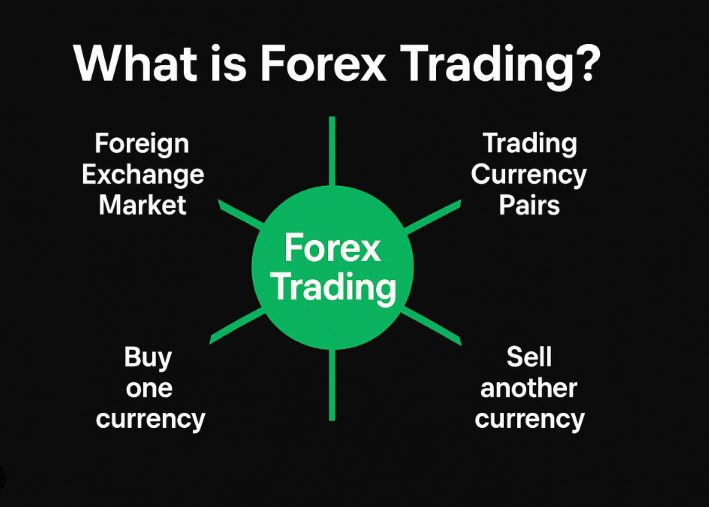
What is Forex Trading?
Forex stands for Foreign Exchange—the process of buying one country's currency and selling another.
Let's make it simple 👇
Imagine you buy the US Dollar at 110 and later sell it at 115. The 5-unit difference is your profit. That's the basic idea behind Forex trading.
🔹 What is the Forex Market?
The Forex market is the largest financial market in the world, with trillions of dollars traded every day. Traders buy and sell different currency pairs to profit from price movements.
Examples:
EUR/USD (Euro vs US Dollar)
GBP/USD (British Pound vs US Dollar)
🔹 How Does Forex Trading Work?
1. Open a Trading Account
Choose a regulated broker and open a trading account using platforms such as:
MetaTrader 4 (MT4)
MetaTrader 5 (MT5)
2. Deposit Funds
Fund your account with an amount you're comfortable starting with, such as $10, $50, or more.
3. Buy or Sell
If you believe the price will rise, place a Buy trade.
If you believe the price will fall, place a Sell trade.
4. Profit or Loss
If the market moves in your predicted direction, you make a profit. If it moves against you, you incur a loss.
🔹 What Do You Need to Learn Forex?
✅ Basic Forex Knowledge
✅ Candlestick Chart Reading
✅ Market Analysis (Technical & Fundamental)
✅ Risk Management (The Most Important Skill)
⚠️ The Reality of Forex Trading
Forex is not a get-rich-quick scheme.
Many beginners believe they can make easy money overnight, but that's one of the biggest misconceptions.
The truth is:
Around 90% of new traders lose money.
Trading without proper education, practice, and discipline is likely to result in losses.
🔹 Advice for Beginners
Start with a Demo Account before risking real money.
Forex stands for Foreign Exchange—the process of buying one country's currency and selling another.
Let's make it simple 👇
Imagine you buy the US Dollar at 110 and later sell it at 115. The 5-unit difference is your profit. That's the basic idea behind Forex trading.
🔹 What is the Forex Market?
The Forex market is the largest financial market in the world, with trillions of dollars traded every day. Traders buy and sell different currency pairs to profit from price movements.
Examples:
EUR/USD (Euro vs US Dollar)
GBP/USD (British Pound vs US Dollar)
🔹 How Does Forex Trading Work?
1. Open a Trading Account
Choose a regulated broker and open a trading account using platforms such as:
MetaTrader 4 (MT4)
MetaTrader 5 (MT5)
2. Deposit Funds
Fund your account with an amount you're comfortable starting with, such as $10, $50, or more.
3. Buy or Sell
If you believe the price will rise, place a Buy trade.
If you believe the price will fall, place a Sell trade.
4. Profit or Loss
If the market moves in your predicted direction, you make a profit. If it moves against you, you incur a loss.
🔹 What Do You Need to Learn Forex?
✅ Basic Forex Knowledge
✅ Candlestick Chart Reading
✅ Market Analysis (Technical & Fundamental)
✅ Risk Management (The Most Important Skill)
⚠️ The Reality of Forex Trading
Forex is not a get-rich-quick scheme.
Many beginners believe they can make easy money overnight, but that's one of the biggest misconceptions.
The truth is:
Around 90% of new traders lose money.
Trading without proper education, practice, and discipline is likely to result in losses.
🔹 Advice for Beginners
Start with a Demo Account before risking real money.
Abdur Rahman Rana
Don't worry about whether a trade hits Stop Loss (SL) or Take Profit (TP). Those outcomes are part of trading.
Focus on what you can control:
Stay consistent.
Follow proper money management.
Keep your risk aligned with your account size.
Use fixed Stop Loss and Take Profit levels according to your trading plan.
Success doesn't come from winning every trade. It comes from executing the same proven process with discipline and consistency over time.
Focus on what you can control:
Stay consistent.
Follow proper money management.
Keep your risk aligned with your account size.
Use fixed Stop Loss and Take Profit levels according to your trading plan.
Success doesn't come from winning every trade. It comes from executing the same proven process with discipline and consistency over time.
Abdur Rahman Rana
No Setup, No Trade. 📊
A professional trader’s greatest strength is patience.
If there is no valid setup according to your trading plan, there is no need to force an entry in the market.
✅ No Setup = No Trade
✅ No Trade = No Loss
✅ Capital protection comes first
Remember, the goal of trading is not to trade every day. The goal is to wait for high-probability setups and take quality trades only.
“The market will always be there. Protect your capital and wait for your setup.” 💯📈
A professional trader’s greatest strength is patience.
If there is no valid setup according to your trading plan, there is no need to force an entry in the market.
✅ No Setup = No Trade
✅ No Trade = No Loss
✅ Capital protection comes first
Remember, the goal of trading is not to trade every day. The goal is to wait for high-probability setups and take quality trades only.
“The market will always be there. Protect your capital and wait for your setup.” 💯📈
Abdur Rahman Rana
🌳 Trading Has Seasons Too
A few losing trades don't mean your strategy is broken.
Just like a tree changes with every season but keeps its roots strong, the market also changes—trending, ranging, volatile, and calm.
🎯 Stay rooted in a well-tested strategy. 🛡️ Protect your capital. 📊 Manage risk. 🧠 Stay disciplined and patient.
Don't change your strategy because of a few losses. Change it only after solid data and proper review.
Consistency beats emotion. Every time. 💯
A few losing trades don't mean your strategy is broken.
Just like a tree changes with every season but keeps its roots strong, the market also changes—trending, ranging, volatile, and calm.
🎯 Stay rooted in a well-tested strategy. 🛡️ Protect your capital. 📊 Manage risk. 🧠 Stay disciplined and patient.
Don't change your strategy because of a few losses. Change it only after solid data and proper review.
Consistency beats emotion. Every time. 💯
Abdur Rahman Rana
No Emotion. Just Execution. 📉
The market doesn't reward emotions—it rewards discipline.
Your responsibility is not to predict every move or react to every candle. Your responsibility is to execute your trading plan with consistency and precision.
Most traders don't fail because of poor strategies. They fail because they abandon their rules when fear, greed, or impatience takes control.
Every trade is simply another execution of your edge. Some will win. Some will lose. What matters is that you remain disciplined enough to follow your system without hesitation or emotional interference.
Master your emotions, trust your process, and let probabilities work over time.
In trading, discipline isn't just an advantage—it's survival. 📊
The market doesn't reward emotions—it rewards discipline.
Your responsibility is not to predict every move or react to every candle. Your responsibility is to execute your trading plan with consistency and precision.
Most traders don't fail because of poor strategies. They fail because they abandon their rules when fear, greed, or impatience takes control.
Every trade is simply another execution of your edge. Some will win. Some will lose. What matters is that you remain disciplined enough to follow your system without hesitation or emotional interference.
Master your emotions, trust your process, and let probabilities work over time.
In trading, discipline isn't just an advantage—it's survival. 📊
Abdur Rahman Rana
The system lost, not me. 📈
I always follow my trading system. Whether a trade hits Stop Loss (SL) or Take Profit (TP) is not what matters most. What matters is whether I executed my trading plan exactly as designed.
If a trade ends in a loss, I still tell myself:
"I did a good job because I followed my system."
A losing trade does not mean you are a losing trader. Even the best trading systems have losing trades. That's why I always say:
"The system lost—not me."
This mindset is what separates consistently profitable traders from everyone else.
Trading is a game of probabilities—not certainty. My job is not to predict the next trade. My job is to follow my rules, manage risk, and stay disciplined.
Trust the process. Follow the system. Stay consistent. The results will follow.
I always follow my trading system. Whether a trade hits Stop Loss (SL) or Take Profit (TP) is not what matters most. What matters is whether I executed my trading plan exactly as designed.
If a trade ends in a loss, I still tell myself:
"I did a good job because I followed my system."
A losing trade does not mean you are a losing trader. Even the best trading systems have losing trades. That's why I always say:
"The system lost—not me."
This mindset is what separates consistently profitable traders from everyone else.
Trading is a game of probabilities—not certainty. My job is not to predict the next trade. My job is to follow my rules, manage risk, and stay disciplined.
Trust the process. Follow the system. Stay consistent. The results will follow.
: