 Tutti gli ordini
 Regolamenti
Guarda come ordinare un robot di trading
Leggi le Regole prima di pubblicare un ordine o di eseguirlo.
Come Ordinare un Robot di Trading in MQL5 e MQL4
Visualizza un esempio di Specifiche dei requisiti necessarie per ordinare un robot
Nuovi ordini nella categoria:
100 - 200 USD
40 - 60 USD
90+ USD
90 - 125 USD
Lavoro terminato
Tempo di esecuzione 42 giorni
Specifiche
Hi,
I'm seeking an experienced coder with advanced mathematical understanding to let him programm a complex custom indicator that will later be part of the corresponding final EA. Budget is $ 90.00 (only for the indicator) here on mql5.com. Who can do this accurately?Best,
Ben
PS: Here's the description of the requested indicator SupRes_v1:
Concept:
SupRes_v1 detects strong up/down price movements followed by a support/resistance area and draws a down(sell.order) / up(buy.order) arrow contrary to said strong movement. The requested indicator also plots lines for suggested fixed SL/TP levels along with said arrows that symbolize the recommended trading direction.
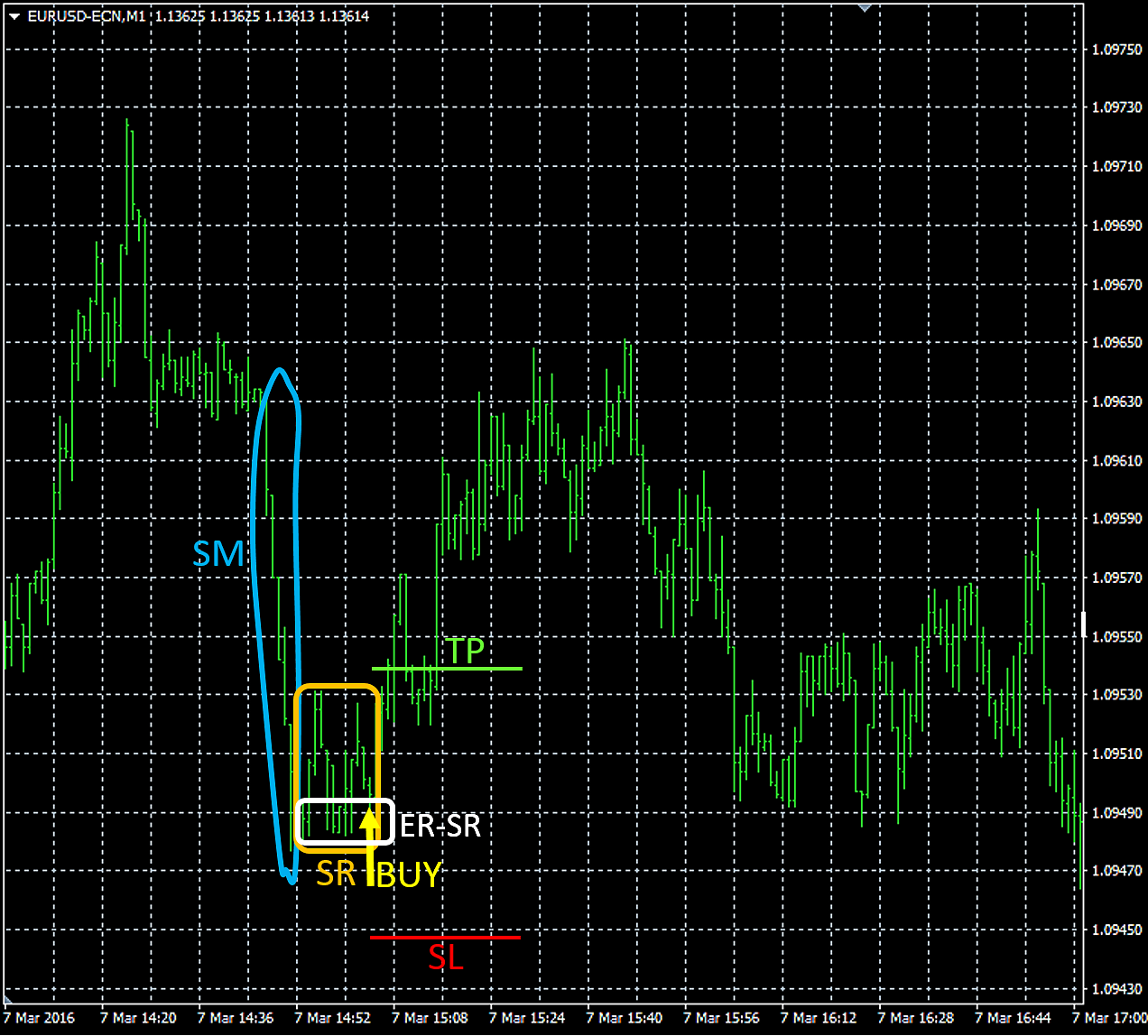
It is recommended to open the attached image resp. figure in a separate browser tab etc. for a better understanding when reading the detailed description below.
Description in detail:
Stage 1:
The fx chart resp. price makes a strong up(sell.order) / down(buy.order) movement for at least n bars. A strong movement (SM) must be calculated as follows:
SM = [(Difference in points between the highest high and the lowest low of the last n closed bars)/n]/[SUM(length of n bars)]
In the Indis GUI the user must also be able to define the minimum value for SM:
-> Minimum value of SM: 0.55 [etc.]
-> Minimum number n of SM bars: 5 [etc.]
If e.g. SM = 0.60, the strong movements bars overlapping value must be averagely maximum 40 %.
If e.g. SM = 1.00, the strong movement consist of consecutive, averagely non-overlapping bars.
If e.g. SM > 1.00, the strong movements bars MUST have partly gaps between each other.
The indi must permanently scan the charts last n closed bars and recognize if all conditions for a valid SM are fulfilled.
Once a SM is detected the indi must note the value resp. price of SMs lowest low and highest high and their positions (time/date). From then on the indi must continually check resp. recalculate if the movement stays strong (definition see above) when including the follow-up bars n+1, n+2, n+3, , n+x (instead of calculating only with n) and ONLY IN THIS CASE update the values/dates for SMs lowest low and highest high (see above).
Furthermore a potential SM(n) resp. SM(n+x) must be ignored by the indi if it exceeds maximum points of distance SM or undercuts minimum points of distance SM, whereby distance = difference between the highest high and the lowest low of all SM valid closed bars (n+x):
-> Maximum points of distance SM: 300 [etc. (if TF = M1)]
-> Minimum points of distance SM: 70 [etc. (if TF = M1)]
Stage 2:
The strong movement slows down. This means that the Minimum value for SMs n bars: 0.55 [etc.] is undercut by the currently closed n+x+1 bar e.g. SMs calculated current actual value shrinks from >0.55 to 0.54 or 0.43 etc. In this case the indi must make the final notation of SMs lowest low / highest high (see above) BUT EXCLUDING the last closed bar that caused the end of SM!
Now the bars of SM consist of the initial bar (IB) followed by n-1 bars + x bars that let the movement stay strong (x can also be 0!) including the final SM bar (FB), before SM is terminated by the terminating bar (TB) which already belongs to the support/resistance area (SR), see below.
Stage 3:
The strong movement (SM) is per definition followed by a support/resistance area (SR). Now the indi must check if at least the next k closed bars within SR starting with TB (see above) are fulfilling the following conditions:
1.) The difference of SRs k bars highest high and lowest low must be a maximum percentage (SR-MP) in relation to SM:
-> Maximum value for SR-MP: 0.35 [etc.]
-> Minimum number k of SR bars: 5 [etc.]
If e.g. SR-MP = 0.35, the k bars in the support/resistance area (SR) are all swinging within a range of maximum 35 % in relation to the strong movements (SM) distance [calculated according to Stage 1).
2.) At least e bars of the k closed bars (within SR, see above) have a high(sell.order) / low(buy.order) that is close to the highest.high(sell.order) / lowest.low(buy.order) of SM-SR, whereby SM-SR includes ALL closed bars starting with IB (initial bar of SM) and ending with the last closed CURRENT bar. Said e bars upper/bottom extrema [high(sell.order) / low(buy.order)] must be in a specified range [in points]; for example 2 bars out of 5 within SR are close to each other AND close to said extremum of SM-SR:
-> Maximum range of SRs e bars: 10 [etc.]
-> Minimum number e of SR bars with similar extrema: 2 [etc.]
If Minimum number e of SR bars with similar extrema = 0, there MUST NOT be any couple/triplet etc. of bars with similar extrema but CAN BE.
3.) At least the l last closed bars of k are lower(sell.order) / higher(buy.order) OR EQUAL to the corresponding extremum of SM-SR:
-> Minimum number l of SRs last bars with lower/higher extremum: 2 [etc.]
If Minimum number l of SRs last bars with lower/higher extremum = 0, the last closed bars within k have no further restriction at this point.
NOTE:
If not all conditions of Stage 3 are fulfilled at the close of bar k, the indi must continually check resp. recalculate them with bars k+1 (instead of k), then k+2 (instead of k+1), then k+3 (instead of k+2), and so on. This process will end if
a) all conditions are fulfilled
or
b) Maximum value for SR-MP is exceeded by the currently processed bar.
If b) occurs the indi must go back to resp. start again with Stage 1.
If a) occurs the indi must proceed with Stage 4 (see below).
Stage 4:
If all conditions of Stage 3 are fulfilled the indi must wait until the current price reaches the end region of SR = ER-SR. The ER-SR is per definition located in the upper(sell.order) / bottom(buy.order) area of SR and finally ending with the SRs highest.high(sell.order) / lowest.low(buy.order). ER-SR must be set in the GUI by the user as a percentage of the distance between the highest high and the lowest low of SR:
-> ER-SRs percentage for entry price level: 0.25 [etc.]
In this case the current price must reach the top(sell.order) / bottom(buy.order) 25% of SR to fulfill this condition.
If said value is set to e.g. 1.25 (= 125%) the current price must exceed(sell.order) / undercut(buy.order) SRs highest.high(sell.order) / lowest.low(buy.order) with a distance of at least 25% SR, whereby distance of SR = highest.high - lowest.low of the current/actual SR in points.
This means that all values above 1.00 result in an price must exceed(sell.order) / undercut(buy.order) a special price level that lies OUTSIDE SR. This calculation is NOT the same as for values between 0.00 and 1.00, because the latter values result in an price must reach specific area.
NOTE:
Its very important that all follow-up bars after Stage 3 resp. while Stage 4 must apart from that ALSO be in the range of Maximum value for SR-MP [see Stage 3: 1.)], even the currently processed (not closed) bar!
As soon as a (current) follow-up bar of Stage 4 exceeds Maximum value for SR-MP before reaching ER-SR (see above) the indi must go back resp. start again with Stage 1.
Stage 5:
If all conditions of Stage 4 are fulfilled the indi must draw a colored down(sell.order) / up(buy.order) arrow above/below the current price reaching ER-SR (see above):
-> Color of the up/buy arrow: yellow [etc.]
-> Color of the down/sell arrow: yellow [etc.]
Furthermore the indi must calculate and draw suggested fixed SL/TP levels (horizontal thin and dotted lines with a length of 20 bars):
-> Color of the fixed SL line: red [etc.]
-> Color of the fixed TP line: lime [etc.]
The value resp. price level of SL/TP must be calculated as follows:
A user defined percentage of the difference highest.high and lowest.low of the whole movement IB->ArrowBar is converted to points and
for SL added(sell.order) to / subtracted(buy.order) from the arrows price level
resp.
for TP subtracted(sell.order) from / added(buy.order) to the arrows price level:
-> SM-SRs percentage for calculating SL buy: 0.35 [etc.]
-> SM-SRs percentage for calculating TP buy: 0.25 [etc.]
-> SM-SRs percentage for calculating SL sell: 0.40 [etc.]
-> SM-SRs percentage for calculating TP sell: 0.20 [etc.]
Furthermore the final SL/TP levels must ALWAYS be expanded by a user set spread (in points) that best represents the brokers average:
-> Spread added to expand TP/SL: 12 [etc.]
Stage 6:
After an arrow and its corresponding TP/SL lines were drawn by the indi the latter must pause all further calculations for the current signal triggering bar AND for r (recess) follow-up bars. After r bars it starts again with Stage 1:
-> Number of recess bars after signal: 10 [etc.]
NOTE: The indi must be 100 % non-repaint and every arrow resp. TP/SL line will stay forever!
Extra filter:
If enabled, all potential sell/buy signals will be skipped if not at least b bars BEFORE SM have a lower.high(sell.order) / higher.low(buy.order) than the highest.high(sell.order) / lowest.low(buy.order) of SM-SR with at least p points difference:
-> Enable extra filter: true/false
-> Minimum number of lower/higher bars b before SM: 100 [etc.]
-> Minimum points of lower/higher bars before SM: 120 [etc.]
!! Please optimize the indicator for the lowest possible CPU usage thx !!
Con risposta
1
Valutazioni
Progetti
149
36%
Arbitraggio
29
3%
/
55%
In ritardo
35
23%
Gratuito
2
Valutazioni
Progetti
120
34%
Arbitraggio
17
18%
/
41%
In ritardo
51
43%
Gratuito
3
Valutazioni
Progetti
396
28%
Arbitraggio
70
19%
/
49%
In ritardo
121
31%
In elaborazione
4
Valutazioni
Progetti
301
30%
Arbitraggio
54
24%
/
56%
In ritardo
98
33%
Gratuito
Ordini simili
Please may someone assist me with the indicator attached, it has a SERIOUS BUG issue in the sense that when I load it, and activate the template (attached as well) MT4 ALWAYS freezes and then eventually disconnects automatically, ALL THE TIME. It even gets worse to an extent that after disconnecting a number of times mt4 ends up not loading anymore, UNTIL I remove the indicator. Please I WILL NEED A DEMO (FOR A DAY)
A trending candle followed by a smaller trending candle which is the second candle with no 5EMA The 3rd candle is a reversal candle in which it and it's immidiate previous candle must be at least 70% of each other's body or equal body, with no 5EMA touch the 3rd candle candle is followed immediately by the 4th candle which is the signal candle in which it and the 1st cabdle must be also at least 70% of
LynxMT5algo
30 - 100 USD
An mt5 add on indicator like gainalgo style to show entrance and exit areas for gold silver and Btc scalping. It will be used to make trading more easy for beginners
Simple Added Notice For Existing Indicator
50 - 200 USD
I have the Fisher Indicator shown below the chart. I need an alert added for when the Fisher Indicator hits the 50 point at the end of each period. GBPUSD and EURUSD 4H charts are provided and I can provide additional
Hello here, I need someone who can work on pinescript and also with Renko charts. My entries for my strategy would be based on stop orders Kindly let me know if you can work on this for me and i will send necessary file and quote in the chat
EA Recovery Layer
30+ USD
Freelance Task — EA Recovery Layer Hello. I have a ready-made MQL5 EA. The signals, SL/TP and lot calculation should essentially not be touched. I need a recovery system added. I am not a programmer — below is how the robot should behave. What stays Entry only from an EA signal. Stop-loss is not a new signal. Trailing is already built into my EA — recovery does not implement its own trailing. If trailing is disabled
# SNRZ BOT — SESSION PROGRESS LOG Last updated: 2026-09-16 (local late-evening session) ## SAN BOT (new — cloned from SNRZ) - `MQL5\Experts\AutomatedOrderBot_SAN.mq5` / `.ex5` — v1.0, compiled 0 errors/0 warnings - Signal source: custom indicator "SAN" (InpSANName, buy buf 0 / sell buf 1, target bar 1), same SNRZ-style read, MA fallback if missing - Magic number 234567 (separate from SNRZ 123456 so both bots can run
Should be as it but no alarms, also we need to add a deep search so he can see all the preves candles and a memory function so its not slowing down the indicator. for higher time frames daily 4h 1h around 365 days and for lower time frames we do up to 20k bars but both flexible so i can change it later. the memory is important so the indicator is not always recalculating everything when a new candle shows especially
Hi, I need an experienced NinjaTrader 8/NinjaScript developer to finish or rebuild an automated futures strategy, ideally by the end of this week. I already have the complete TradingView Pine Script reference strategy, an existing ~2,000-line NinjaScript implementation, Playback logs, and known historical benchmark trades. MOST IMPORTANT REQUIREMENT: TRADINGVIEW ↔ NINJATRADER PARITY. The Pine Script is the reference
I need a custom MQL5 indicator for MetaTrader 5. The indicator must automatically print entry, stop loss, and take profit zones on the chart using dots. A critical requirement is that these dots must be non-lagging and absolutely non-repainting. Additionally, the indicator needs to identify and display current supply and demand zones. Please provide the mq5 source code and the ex5 file upon completion
Informazioni sul progetto
Budget
40 - 90 USD
Scadenze
da 1 a 4 giorno(i)