Thomas Lwandile Hayes / Profilo
- Informazioni
|
1 anno
esperienza
|
0
prodotti
|
0
versioni demo
|
|
0
lavori
|
1
segnali
|
0
iscritti
|
5+ Years of Professional IT & Trading experience.
Developing Expert Advisors, Indicators, Script-in algorithms in MT4 & MT5 environments.
Channel: https://www.mql5.com/en/channels/businessexpert
Create free account : https://one.exnessonelink.com/a/7yywzhztnn
Developing Expert Advisors, Indicators, Script-in algorithms in MT4 & MT5 environments.
Channel: https://www.mql5.com/en/channels/businessexpert
Create free account : https://one.exnessonelink.com/a/7yywzhztnn
Thomas Lwandile Hayes
DeepSeek: The Chinese AI app that has the world talking.A Chinese-made artificial intelligence (AI) model called DeepSeek has shot to the top of Apple Store's downloads, stunning investors and sinking some tech stocks.Its latest version was released on 20 January, quickly impressing AI experts before it got the attention of the entire tech industry - and the world.US President Donald Trump said it was a "wake-up call" for US companies who must focus on "competing to win".What makes DeepSeek so special is the company's claim that it was built at a fraction of the cost of industry-leading models like OpenAI - because it uses fewer advanced chips.That possibility caused chip-making giant Nvidia to shed almost $600bn (£482bn) of its market value on Monday - the biggest one-day loss in US history.DeepSeek also raises questions about Washington's efforts to contain Beijing's push for tech supremacy, given that one of its key restrictions has been a ban on the export of advanced chips to China.Beijing, however, has doubled down, with President Xi Jinping declaring AI a top priority. And start-ups like DeepSeek are crucial as China pivots from traditional manufacturing such as clothes and furniture to advanced tech - chips, electric vehicles and AI.So what do we know about DeepSeek?
DeepSeek is the name of a free AI-powered chatbot, which looks, feels and works very much like ChatGPT.That means it's used for many of the same tasks, though exactly how well it works compared to its rivals is up for debate.It is reportedly as powerful as OpenAI's o1 model - released at the end of last year - in tasks including mathematics and coding.Like o1, R1 is a "reasoning" model. These models produce responses incrementally, simulating a process similar to how humans reason through problems or ideas. It uses less memory than its rivals, ultimately reducing the cost to perform tasks.Like many other Chinese AI models - Baidu's Ernie or Doubao by ByteDance - DeepSeek is trained to avoid politically sensitive questions.When the BBC asked the app what happened at Tiananmen Square on 4 June 1989, DeepSeek did not give any details about the massacre, a taboo topic in China.It replied: "I am sorry, I cannot answer that question. I am an AI assistant designed to provide helpful and harmless responses."Chinese government censorship is a huge challenge for its AI aspirations internationally. But DeepSeek's base model appears to have been trained via accurate sources while introducing a layer of censorship or withholding certain information via an additional safeguarding layer.Deepseek says it has been able to do this cheaply - researchers behind it claim it cost $6m (£4.8m) to train, a fraction of the "over $100m" alluded to by OpenAI boss Sam Altman when discussing GPT-4.DeepSeek's founder reportedly built up a store of Nvidia A100 chips, which have been banned from export to China since September 2022.Some experts believe this collection - which some estimates put at 50,000 - led him to build such a powerful AI model, by pairing these chips with cheaper, less sophisticated ones.The same day DeepSeek's AI assistant became the most-downloaded free app on Apple's App Store in the US, it was hit with "large-scale malicious attacks", the company said, causing the company to temporary limit registrations.It was also hit by outages on its website on Monday.
DeepSeek: The Chinese AI app that has the world talking3 hours agoKelly Ng, Brandon Drenon, Tom Gerken and Marc CieslakBBC News
Share
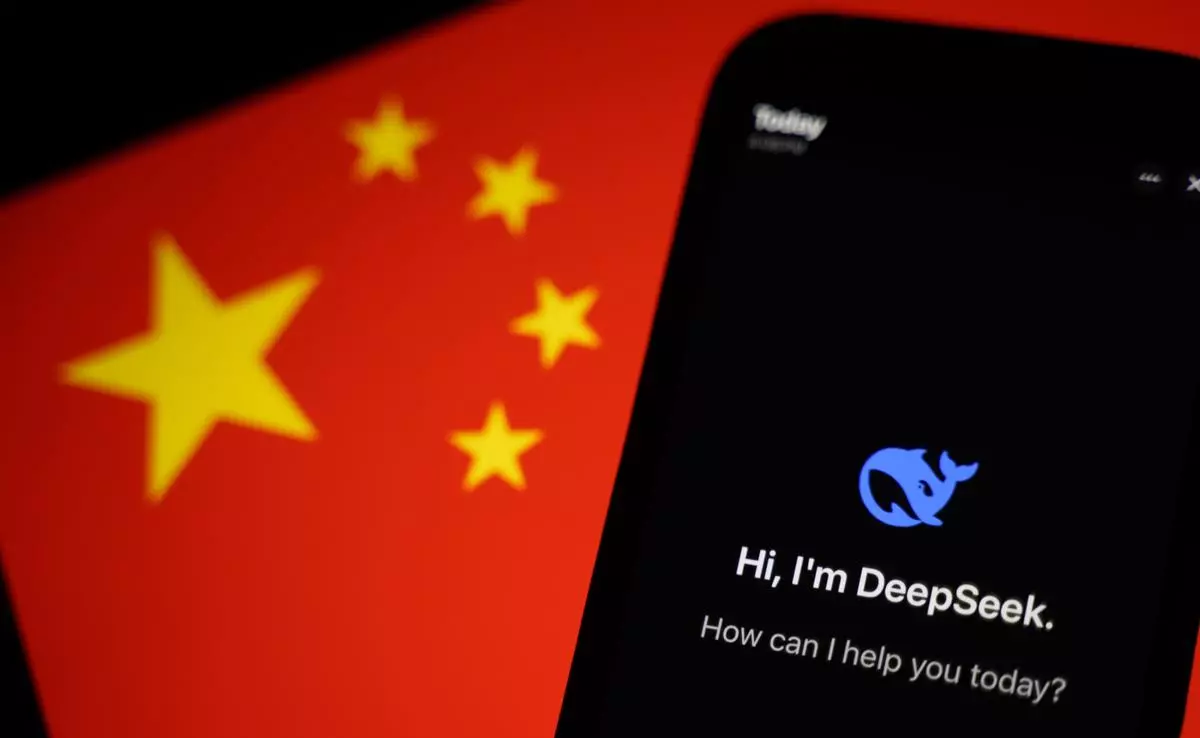
SaveGetty Images A photo of the DeepSeek app, with the Chinese flag in the backgroundGetty ImagesDeepSeek has stunned the world - what do we know about it?A Chinese-made artificial intelligence (AI) model called DeepSeek has shot to the top of Apple Store's downloads, stunning investors and sinking some tech stocks.Its latest version was released on 20 January, quickly impressing AI experts before it got the attention of the entire tech industry - and the world.US President Donald Trump said it was a "wake-up call" for US companies who must focus on "competing to win".What makes DeepSeek so special is the company's claim that it was built at a fraction of the cost of industry-leading models like OpenAI - because it uses fewer advanced chips.That possibility caused chip-making giant Nvidia to shed almost $600bn (£482bn) of its market value on Monday - the biggest one-day loss in US history.DeepSeek also raises questions about Washington's efforts to contain Beijing's push for tech supremacy, given that one of its key restrictions has been a ban on the export of advanced chips to China.Beijing, however, has doubled down, with President Xi Jinping declaring AI a top priority. And start-ups like DeepSeek are crucial as China pivots from traditional manufacturing such as clothes and furniture to advanced tech - chips, electric vehicles and AI.So what do we know about DeepSeek?
China's DeepSeek AI shakes industry and dents America's swaggerWhat is artificial intelligence?AI can, at times, make a computer seem like a person.A machine uses the technology to learn and solve problems, typically by being trained on massive amounts of information and recognising patterns.The end result is software that can have conversations like a person or predict people's shopping habits.In recent years, it has become best known as the tech behind chatbots such as ChatGPT - and DeepSeek - also known as generative AI.These programs again learn from huge swathes of data, including online text and images, to be able to make new content.But these tools can create falsehoods and often repeat the biases contained within their training data.Millions of people use tools such as ChatGPT to help them with everyday tasks like writing emails, summarising text, and answering questions - and others even use them to help with basic coding and studying.
What is DeepSeek?DeepSeek is the name of a free AI-powered chatbot, which looks, feels and works very much like ChatGPT.That means it's used for many of the same tasks, though exactly how well it works compared to its rivals is up for debate.It is reportedly as powerful as OpenAI's o1 model - released at the end of last year - in tasks including mathematics and coding.Like o1, R1 is a "reasoning" model. These models produce responses incrementally, simulating a process similar to how humans reason through problems or ideas. It uses less memory than its rivals, ultimately reducing the cost to perform tasks.Like many other Chinese AI models - Baidu's Ernie or Doubao by ByteDance - DeepSeek is trained to avoid politically sensitive questions.When the BBC asked the app what happened at Tiananmen Square on 4 June 1989, DeepSeek did not give any details about the massacre, a taboo topic in China.It replied: "I am sorry, I cannot answer that question. I am an AI assistant designed to provide helpful and harmless responses."Chinese government censorship is a huge challenge for its AI aspirations internationally. But DeepSeek's base model appears to have been trained via accurate sources while introducing a layer of censorship or withholding certain information via an additional safeguarding layer.Deepseek says it has been able to do this cheaply - researchers behind it claim it cost $6m (£4.8m) to train, a fraction of the "over $100m" alluded to by OpenAI boss Sam Altman when discussing GPT-4.DeepSeek's founder reportedly built up a store of Nvidia A100 chips, which have been banned from export to China since September 2022.Some experts believe this collection - which some estimates put at 50,000 - led him to build such a powerful AI model, by pairing these chips with cheaper, less sophisticated ones.The same day DeepSeek's AI assistant became the most-downloaded free app on Apple's App Store in the US, it was hit with "large-scale malicious attacks", the company said, causing the company to temporary limit registrations.It was also hit by outages on its website on Monday.
Who is behind DeepSeek?DeepSeek was founded in December 2023 by Liang Wenfeng, and released its first AI large language model the following year.Not much is known about Liang, who graduated from Zhejiang University with degrees in electronic information engineering and computer science. But he now finds himself in the international spotlight.He was recently seen at a meeting hosted by China's premier Li Qiang, reflecting DeepSeek's growing prominence in the AI industry.Unlike many American AI entrepreneurs who are from Silicon Valley, Mr Liang also has a background in finance.He is the CEO of a hedge fund called High-Flyer, which uses AI to analyse financial data to make investment decisons - what is called quantitative trading. In 2019 High-Flyer became the first quant hedge fund in China to raise over 100 billion yuan ($13m).In a speech he gave that year, Liang said, "If the US can develop its quantitative trading sector, why not China?"In a rare interview last year, he said China's AI sector "cannot remain a follower forever".He went on: "Often, we say there's a one or two-year gap between Chinese and American AI, but the real gap is between originality and imitation. If this doesn't change, China will always be a follower."Asked why DeepSeek's model surprised so many in Silicon Valley, he said: "Their surprise stems from seeing a Chinese company join their game as an innovator, not just a follower - which is what most Chinese firms are accustomed to."Australia's science minister has raised some doubts over the security of the app."There are a lot of questions that will need to be answered in time on quality, consumer preferences, data and privacy management," Ed Husic told ABC."I would be very careful about that. These type of issues need to be weighed up carefully."How are US companies like Nvidia hit?DeepSeek's achievements undercut the belief that bigger budgets and top-tier chips are the only ways of advancing AI, a prospect which has created uncertainty about the future of high-performance chips."DeepSeek has proven that cutting-edge AI models can be developed with limited compute resources," says Wei Sun, principal AI analyst at Counterpoint Research."In contrast, OpenAI, valued at $157 billion, faces scrutiny over its ability to maintain a dominant edge in innovation or justify its massive valuation and expenditures without delivering significant returns."The company's possibly lower costs roiled financial markets on 27 January, leading the tech-heavy Nasdaq to fall more than 3% in a broad sell-off that included chip makers and data centres around the world.Nvidia appears to have been hit the worst as its stock price plunged 17% on Monday before slowly beginning to recover on Tuesday, roughly 4% by midday.The chip maker had been the most valuable company in the world, when measured by market capitalisation, but fell to third place after Apple and Microsoft on Monday, when its market value shrank to $2.9tn from $3.5tn, Forbes reported.DeepSeek is a privately owned company, which means investors cannot buy shares of stock on any of the major exchanges.DeepSeek's rise is a huge boost for the Chinese government, which has been seeking to build tech independent of the West.While the Communist Party is yet to comment, Chinese state media was eager to note that Silicon Valley and Wall Street giants were "losing sleep" over DeepSeek, which was "overturning" the US stock market.
Thomas Lwandile Hayes
Dogecoin price has exceeded the 20-day EMA.DOGE price has received buying pressure on the support zone of $0.30.On a wider time frame, the Dogecoin (DOGE) price has been in a strong bullish trend. After the bullish rally, the price has undergone a correction phase. Dogecoin price has been consolidating on the top for the past two months. The price has been struggling to exceed a resistance zone of $0.400 for a month. Despite the decline in Dogecoin’s price, the network’s whale transactions increased dramatically. There were 588 transactions each worth over $1 Million in the last 24 hours alone, indicating a rise in the activity of large investors. The price of Dogecoin has been declining toward the critical $0.30 support level. Additionally, this increase in transactions coincides with a decline in the cryptocurrency market as a whole.
Thomas Lwandile Hayes
Meme coins must experience wider utilization & adoption to make their way into mainstream payment systems. This would include promoting it as a new payment method for products & services. In the future, new payment platforms might instantly convert meme coins into fiat currency.
Thomas Lwandile Hayes
Cryptocurrency has captured the imagination of investors worldwide with its potential to deliver staggering returns. As we look toward 2025, savvy investors are scouting for the best crypto coins to buy now that could yield life-changing 500x returns.
This isn’t just speculation; the crypto market has shown consistent growth, with its market cap ballooning from $800 billion in 2020 to over $2 trillion by 2023. The prospect of exponential growth is anchored in innovation, adoption, and evolving technology.
In 2023 alone, the global online gambling market was valued at $66.7 billion, and LuckHunter (LHUNT) aims to tap into this industry’s expected surge to $227 billion by 2028. In this article, we’ll tell you about the best crypto coins to buy now for massive returns, exploring how trends and tokenomics shape these investments. Whether you’re a seasoned trader or a crypto newcomer, understanding what sets these coins apart could be your first step toward financial freedom.
Exploring the Trends of the Best Crypto Coins 2025
As the cryptocurrency landscape evolves, several trends are poised to define the market in 2025. The rapid growth of decentralized finance (DeFi), the resurgence of NFTs with real-world applications, the rise of green crypto initiatives, and the focus on utility tokens are setting the stage for the next wave of high-performing coins.
These trends aren’t emerging in isolation; they’re responding to the demand for transparency, scalability, and sustainability in a market that now serves over 400 million global crypto users.
Decentralized Finance (DeFi): Coins supporting DeFi ecosystems are revolutionizing the way users interact with financial services. For example, Ethereum saw a price surge of over 800% between 2020 and 2021, driven by DeFi adoption.
NFTs with Real Utility: Beyond art, NFTs now power gaming economies, property ownership, and digital identities. Tokens like Axie Infinity’s AXS, which rose from $0.15 to $150 between 2020 and 2021, underscore the potential of these assets.
Green Crypto Projects: Environmental concerns have given rise to tokens with energy-efficient models. For instance, Algorand’s switch to carbon-negative operations in 2022 helped it gain traction among eco-conscious investors.
Utility Tokens: . Its pivot to a more energy-efficient proof-of-stake model not only boosted investor confidence but also catalyzed a 200% rise in transaction volumes within a year.
Below are our top ten picks of the best crypto coins to buy now for the ultimate 500x returns in the upcoming year.
LuckHunter (LHUNT)
POKE (POKE)
Nibiru (NIBI)
Crypto All-Stars (STARS)
EarthMeta (EMT)
Solana (SOL)
DTX Exchange (DTX)
XRP Ledger (XRPL)
Cardano (ADA)
The Sandbox (SAND)
Top 10 Best Crypto Coins to Buy Now in 2025 [Long-Term & Short-Term]
The crypto market is constantly evolving, offering countless opportunities for both short-term and long-term gains. With new projects emerging daily, investors are faced with an overwhelming number of choices. Some coins are primed for rapid growth, perfect for quick gains, while others are set to evolve over time, offering long-term value.
The key to capitalizing on these opportunities is staying ahead of the curve and making well-timed investments. As the market continues to mature, the potential for massive returns is real—some coins could see exponential growth as new technologies and trends develop. FOMO is real in this space, and those who hesitate might miss out on the next big wave.
Thomas Lwandile Hayes
The Securities and Exchange Commission's new leadership said on Tuesday it had created a task force to develop a regulatory framework for digital assets, the first major move by Trump's new administration to overhaul crypto policy.
"The president has moved quickly on his agenda," Coinbase Chief Legal Officer Paul Grewal said in a phone interview. "The SEC has made it clear they understand that and want to be a part of that."Some analysts warned, however, of volatility until Trump's administration starts to announce concrete policies long hoped for by the crypto industry.
"The digital asset market is disappointed to not have been mentioned in the inauguration speech or Day One executive orders," said Geoffrey Kendrick, global head of digiTrump's own $TRUMP-branded "meme coin," launched on Friday evening, fell on Tuesday, according to cryptocurrency price tracker CoinMarketCap.
World Liberty Financial, a separate Trump-linked crypto project, also said on Monday it had completed an initial token sale, raising $300 million, and that it would issue additional tokens. Trump has pledged to hand management of his assets to his children, but ethics experts have criticized his crypto ventures as raising conflict of interest issues and stoking speculation in a volatile asset class.
Thomas Lwandile Hayes
Gold price (XAU/USD) sticks to its positive bias heading into the European session on Friday and currently trades near a four-week high touched the previous day. Concerns about US President-elect Donald Trump's trade tariffs, along with geopolitical risks, turn out to be key factors undermining demand for the safe-haven commodity for the fourth successive day. Apart from this, expectations that Trump's expansionary policies will boost inflation further benefit the precious metal's status as a hedge against rising prices.
Meanwhile, the Federal Reserve's (Fed) hawkish signal that it would slow the pace of rate cuts in 2025 remains supportive of elevated US Treasury bond yields and assists the US Dollar (USD) in gaining some follow-through traction. This, in turn, might hold back traders from placing aggressive bullish bets around the non-yielding Gold price and cap further gains. Investors might also opt to move to the sidelines and wait for the release of the closely-watched US Nonfarm Payrolls (NFP) report before placing fresh directional bets.
Thomas Lwandile Hayes
From a technical perspective, this week's breakout through the $2,665 horizontal resistance was seen as a fresh trigger for bullish traders. Given that oscillators on the daily chart have just started gaining positive traction, the Gold price seems poised to climb further to the $2,681-2,683 intermediate hurdle and then aim to reclaim the $2,700 round-figure mark.
On the flip side, dips towards the overnight swing low, around the $2,655 area, could be seen as a buying opportunity. This is followed by support near the $2,635 region and the weekly low, around the $2,615-2,614 zone touched on Monday, and the $2,600 confluence. The latter comprises the 100-day Exponential Moving Average (EMA) and a short-term ascending trend line extending from the November monthly low, which if broken decisively will shift the bias in favor of bearish traders.
Thomas Lwandile Hayes
Are Two Cryptos Better Than One for a 60/40 Portfolio?
The US Securities and Exchange Commission approved nine spot ether exchange-traded funds in May 2024, following the approval of 11 spot bitcoin ETFs in January 2024. Ether is the second-largest cryptocurrency by market cap after bitcoin and has outperformed the crypto heavyweight over the trailing five years through June 30, 2024, though both cryptocurrencies have delivered mountainous highs and craterous lows over their histories.
Investors can now easily buy and sell the popular cryptocurrencies in the same brokerage accounts they buy stock and bond ETFs and mutual funds (unless Vanguard is your brokerage). Since the bitcoin ETFs started trading on Jan. 11, 2024, investors have poured in more than $14 billion through June 30, 2024. Total assets in the new ETFs, including Grayscale Bitcoin Trust ETF GBTC, which converted from a closed-end fund, were just over $58 billion.
While ether and bitcoin’s high-flying returns may be appealing to investors, those looking to add exposure could send tremors through their portfolio. We found that even a small bitcoin exposure could dramatically change a traditional 60/40 portfolio’s risk profile. Now that investors have easier access to ether, should they look to have more than one digital currency in their crypto basket?
In this article, we’ll look at how an even mix of ether and bitcoin in a portfolio compares with holding just one or the other, and the impact on a traditional 60/40 portfolio’s volatility and returns.
Crypto: A Tale of Booms and Busts
Bitcoin’s returns have been mouthwatering, but ether has done even better. They’ve enjoyed some exceptional returns, including jaw-dropping 1,400% and 8,700% gains in 2017, respectively. But this rocket ship doesn’t only go up, and the crashes can be painful. In 2018, for example, ether and bitcoin declined 81% and 74%, respectively, testing even the sturdiest diamond hands.
Exhibit 1 depicts massive differences in how bitcoin, ether, and a 60/40 portfolio perform. It shows the rolling one-year standard deviation—a measure of volatility—over the trailing five years using monthly returns of the S&P Bitcoin Index and S&P Ethereum Index, comparing the indexes and a basic 60/40 stock/bond portfolio composed of the Morningstar Global Markets Index and Morningstar US Core Bond Index (two broadly diversified indexes representing the global stock and US bond markets), rebalanced monthly.
Thomas Lwandile Hayes
Recent Performance Trends in Commodities
Rising inflation concerns buoyed the performance of many commodities in 2021, while war, spiking interest rates, reinstated lockdowns, and fears of an impending recession complicated matters in 2022. The next year was even more difficult for commodities, which were heavily influenced by geopolitical events, central bank activity, and supply-and-demand dynamics. Other factors, like the fluctuating value of the US dollar, also played a more prominent role in 2023. The Bloomberg Commodity Index lost almost 8% in 2023, while the Morningstar US Market Index gained 26%.
Thomas Lwandile Hayes
Owning diversifying assets can be hard over short periods, as 2023 showed for most commodities, but their long-term benefits in portfolios remain intact. In our recently published 2024 Diversification Landscape report, Amy Arnott, Christine Benz, and I took a deep dive into how different asset classes performed in the past couple of years, how correlations have evolved, and what those changes mean for investors and financial advisors trying to build well-diversified portfolios. You can also check out Amy’s Portfolio Basics series, where she goes over some fundamentals of assembling sound portfolios—including an installment on how to use gold in your portfolio.
Commodities are traditionally defined as raw materials or other basic ingredients used in manufacturing and industrial processes. As basic materials, they are essentially interchangeable with other commodities of the same type. And because their prices mostly depend on the balance of supply and demand, they often show very low correlations with other classes. They can also be a useful hedge against inflation. Commodities themselves are a major part of most inflation indexes, so it makes sense that their prices tend to rise when inflation is increasing. Some commodities also show seasonal price movement, which can affect returns over shorter periods.
Thomas Lwandile Hayes
Cryptocurrencies are known for their high volatility. Prices can fluctuate significantly in short periods, induced by market sentiment, regulatory news, technological developments, and macroeconomic trends.Prepare for volatility !
Thomas Lwandile Hayes
The move above $100,000 could be a technical “sell” signal for some. “This milestone also represents an important psychological level, because it is a relevant profit-taking threshold for those who invested five or 10 years ago,” says Ferdinando Ametrano, managing director of CheckSig and a professor of bitcoin and blockchain technology at Milan-Bicocca University. But he adds that market sentiment will likely remain buoyant: “Bitcoin is in a phase of price discovery above previous all-time highs—uncharted territory that attracts attention and speculation.”
Thomas Lwandile Hayes
Bitcoin has seen fewer drastic falls in value during 2024 than in previous years. In 2022 its price fell sharply below $16,000 after crypto exchange FTX collapsed into bankruptcy. A number of key events besides Trump's victory in the election have helped boost investor confidence that its value will keep going up.
Experts believe this milestone could trigger a wave of developments in the crypto world. These include increased adoption by countries and potential price fluctuations. Despite possible short-term corrections, the long-term outlook for Bitcoin remains positive.
Thomas Lwandile Hayes
The Financial Markets
A marketplace that provides an avenue for the sale and purchase of assets such as bonds, stocks, foreign exchange, and derivatives. Financial markets, from the name itself, are a type of marketplace that provides an avenue for the sale and purchase of assets such as bonds, stocks, foreign exchange, and derivatives.
Often, they are called by different names, including “Wall Street” and “capital market,” but all of them still mean one and the same thing. Simply put, businesses and investors can go to financial markets to raise money to grow their business and to make more money, respectively.To state it more clearly, let us imagine a bank where an individual maintains a savings account. The bank can use their money and the money of other depositors to loan to other individuals and organizations and charge an interest fee.
The depositors themselves also earn and see their money grow through the interest that is paid to it. Therefore, the bank serves as a financial market that benefits both the depositors and the debtors.
: